
EPISODE #113
TAMARA DAY
When Scrappy Becomes the Superpower: Tamara Day on Creating Luxury Without Excess




Luxury, according to Tamara Day, has very little to do with money. Within her process, everything to do with vision.
“It didn’t come from an excess of cash,” she says. “Anybody can spend money and make a room look good. But being able to make a room look good on a budget and still feel luxury, that’s a skill.”
On this episode of The Market Makers, Tamara’s journey to interior design was built upon deeply human moments throughout her life, eventually leading her to great success. She didn’t go to design school. She never apprenticed under a big-name designer. What she had was instinct, an ability to negotiate, and willingness to experiment.
Growing up in Kansas, Tamara watched her parents work relentlessly. Her father bought homes in the best neighborhoods he could afford and finished them at the bare minimum. The houses had good bones but were full of garage-sale furniture. “The lack of design in the houses inspired me,” she recalls. “When I saw beautifully designed homes, I was like, I want that.”
But it was her grandmother who gave her creative freedom, thanks to her knack for crocheting, cooking and crafting. “If it was something she could do with her hands, she did,” Tamara says. “That freedom helped with the aesthetic.” Her goal? Have fun and create, no matter the project.
That foundation mattered most as she grew up, especially during the economic crash of 2008. Mid-renovation, with three small children at home, the financial crisis impacted their family and their newly built home. Her husband’s income dropped 90 percent overnight. Investing in furniture for their new build wasn’t an option. But in this moment of great stress, Tamara found her gift. It started with attending estate sales with the kids, a dollar in each of their hands, learning to negotiate. She bought her first piece, a secretary desk, for $75. From there, she slowly expanded her collection. She spent days painting furniture in the driveway while her kids rode bikes.
“It was a joyful time,” she says. “We had nothing but fun. There was no risk. It was just good times.”
What began as necessity turned into discovery. Tamara realized she could take high-quality vintage pieces and make them feel fresh and elevated. “People will pay more for beautiful,” she explains, “and it doesn’t cost more. That’s the magic.”
Those driveway days led to pop-up sales, design clients, television, and eventually Laid Back Luxe, a book rooted in the same philosophy. “Anybody at any price point can have an aspirational and attainable home,” Tamara says. “It doesn’t all have to be the fanciest thing.”
Her story isn’t about luck. It’s about showing up, trusting your gut and allowing creativity to grow where resources are limited. As Tamara proves, sometimes being scrappy isn’t a setback. It's the key to unlocking a superpower.
Tamara Day:
It didn't come from an excess of cash. Anybody can spend money and make a room look good, but being able to make a room look good on a budget and still feel luxury and high-end is a skill, and that's my secret sauce.
Jon Pertchik:
Today on The Market Makers, how scrappy becomes a superpower. Tamara Day didn't go to design school. She never apprenticed under a famous designer. What she had was an instinct to experiment and push herself creatively, and her family was right alongside her. Tamara's the quintessential supermom. She's the unintentional design genius TV star, who frankly probably never cared about those things much. What she cared about was being a good mom, helping to contribute to the family, and to provide along with her husband. Through recognition of those capabilities, she started working on furniture with her two kids in tow, three kids in tow over time, painting in the driveway while the kids circled around her on bicycles, and started to appreciate what she was creating was beautiful and other people started appreciating that. And from those humble beginnings, she's now in many, many seasons of Bargain Mansions and is a recognized national design celebrity.
Let's go back a bunch of time. I'm interpreting, I guess, growing up, your dad, Ward, would buy and improve homes, you moved a bunch. Maybe speak to some of that, and with the benefit of what you know and where your life has taken you, speak to what that was like and maybe how that might've impacted you.
Tamara Day:
Well, I think that what my parents did really well is that they really taught all of us how to work really, really hard because they worked really, really hard. They didn't have anything, they were both farm kids from one-room school houses out in Western Kansas-
Jon Pertchik:
Wow.
Tamara Day:
... and just grew up with a real do-it-yourself mentality. And it's not like in Salina, Kansas, there's a bunch of designers living there. I'd never even met a designer. And so, I just always appreciated a pretty home, I loved seeing all the different stuff. And we did move a lot as a kid, so we'd move every two to three years with my dad's job when I was young. And so, I feel like I got to see him build these houses from the ground-up, because he always bought the best neighborhood he could afford and built to the bare minimum he could. And they were always house poor, garage sale furniture. For some reason back then, corporate moves would always give you free drapes, you could have new custom drapery in the house, which what a random thing.
Jon Pertchik:
Drapes aren't cheap either, so...
Tamara Day:
No. So the houses always had really great drapes and garage sale furniture. But I think the lack of design in the houses inspired me so that when I saw beautifully designed homes, I was like, "I want that. I want to do that."
Jon Pertchik:
Do you have any sense, other than the contrast of your dad buying high-quality real estate, but just doing the bare minimum, you recognized aesthetic at that point in your life, and just because there's a contrast between what you aspire for and what you have, doesn't necessarily make you aware of aesthetic. Any guess on where... Did either parent-
Tamara Day:
My grandma.
Jon Pertchik:
Okay. All right. Well, we're going to get at something here. So tell me about your grandma and what she gifted you.
Tamara Day:
My grandma was super creative, my dad's mom, and she never cared about the mess of designing whatever it was. And she loved every handcraft, every needlepoint and crochet, just all of it. If it was something she could do with her hands, she did. And she let me make a mess of whatever she was doing right beside her in the kitchen, in the crafting. So I think that freedom that she gave... And my mom was that way as well, very much like just have fun with it and create it. And so, that, I think, helped with the aesthetic. I don't know that the farmhouse needlepoint was exactly where I was going, but it definitely inspired me.
Jon Pertchik:
But it's a spark. So if you think back to those experiences, how far back can you take yourself?
Tamara Day:
Oh, man. I remember spending the summer with my grandma when she had her hip surgery and I stayed all summer to help her, and I think I was like 10, and it was just the best summer. I cooked with her every meal and took out the meals to the harvest crew and would bake cakes every day and get to just do all the fun stuff. And I remember we did stained-glass one day and we did ceramics another-
Jon Pertchik:
Wow.
Tamara Day:
... and then we made soaps another. It was just like the summer of crafting.
Jon Pertchik:
It's like the camp without camp, it's just camp with grandma.
Tamara Day:
With grandma.
Jon Pertchik:
That's amazing. When did you start to realize you have a thing for that, appreciating, engaging in the art of creation?
Tamara Day:
Exactly.
Jon Pertchik:
Either you're drawn toward, you're really good at it. When did you start to have a sense of that it's something within you?
Tamara Day:
I think in college, I wish that I would've known design was a career path. I did not know this was something you can do. But I remember college roommates being like, "Why do we have these nice wine glasses? Why is the solo cup not good enough?" I'm like, "The mug matters. The stuff in the house matters, having great artwork on the walls and painting the rooms." They're like, "You're just going to have to paint it white when we leave." I'm like, "I don't care." So I wish that I'd had a really great advisor in college that would've been like, "Oh, wait, you should do design." I could have had a whole different path to getting here.
Jon Pertchik:
What were you studying?
Tamara Day:
Rhetoric and communication, speech writing, which I guess I'm speaking now, right?
Jon Pertchik:
You've written a book, I think it qualifies.
Tamara Day:
Yes.
Jon Pertchik:
Presumably, you're out of college, you're starting a career of some kind. Maybe share just that next window, that next moment.
Tamara Day:
So after college, I was a pharmaceutical sales rep for a very short minute, and it was not my favorite thing. I was really not creative in any way, and so I kept trying to infuse the creativity, but that's not a creative field. So we were renovating a house at the time, my husband and I, and man, we gutted that down to the studs and started from scratch, and I really fell in love with that. My parents had always built from the ground-up, I'd never considered renovations, and so that was really when that love started.
Jon Pertchik:
So just to double click, because I think it's interesting for people, it sounds like, coming out of school, you took a job to make a living, which is completely normal and healthy, but you had this thing inside you that needed to be expressed, and there was a lesson in that, I think, right?
Tamara Day:
Absolutely.
Jon Pertchik:
Stay true to yourself. Any reflection on that?
Tamara Day:
Yeah. I'm reflecting on it a lot lately, because I have my oldest son, he decided college wasn't his path, and he has been flipping houses for the last year and a half-
Jon Pertchik:
That's awesome.
Tamara Day:
... and he's got two or three buddies that are doing it with him, and they've flipped like 40 houses this year.
Jon Pertchik:
What? In one year?
Tamara Day:
Right.
Jon Pertchik:
Wow.
Tamara Day:
Yeah, they're killing it.
Jon Pertchik:
These are young kids?
Tamara Day:
Yeah, 21, 22, and just killing it and having so much fun.
Jon Pertchik:
That's amazing. I wonder where they got that from.
Tamara Day:
I know. I love it, he calls and he's like, "Hey, Mom, what color should I do? What about this? Can you come walk the house with me and tell me what you think?" How many 21-year-old boys are calling their mom to chat about their job? I feel really blessed in that. And then, my second son is at KU and he's thriving. But also, all his buddies are doing the business degree, and he loves the idea of it because my husband's a financial planner and he's like, "I can see that path." I'm like, "Yeah, but you're a creative. If money was no object, what are you going to do?" And he's like, "I'd probably get an art degree." And I'm like, "Then maybe get an art degree."
Jon Pertchik:
I'd love to share notes too, because my son in his fourth year of a five-year architecture program, he's got a band, he's a great painter, he's really creative, and he said, "I think I want to go into real estate development." I'm like, "Why?" And the why is, "Well, because I want to make money and my friends are all studying finance," and that is the wrong perspective. The old cliche, if you love what you do, you never work a day, you're [inaudible 00:07:34] going to be great at it.
Tamara Day:
Exactly.
Jon Pertchik:
Western Kansas, grandma's farmhouse, estate sales with three boys and a dollar each, an eye for beauty, a tolerance for risk, and the muscle memory of making things work when money runs out. But 2008 was coming, and when Lehman collapsed, everything changed. How did that lead to the inspiration of the Bargain Mansions? Everything you've created, with that brand and that obviously TV, et cetera, all of that media aspect of it, it started there.
Tamara Day:
Well, so my husband's day job was wholesaling for the financial industry, and we had three babies, and I remember rocking Thomas to sleep in the rental house that we were living in while we were renovating this one, we were halfway through, and Lehman went down. And sitting there, I think that was the only time in my life that before bed, I'd look at the stock market every day, because it was a direct reflection of what was happening. And I'd been home for years at that point. And so, that night, his income dropped 90% overnight, and we ended up having to fire the contractor, figure it out.
A few months later, I think it was November/December-ish, and the bank called and they were like, "We're going to have to review the construction loan. We gave you $10 to renovate this house with, and now the comps in the neighborhood, we can only give you five. We're going to need you to bring five back." And I'm like, "Well, good luck. Here's the keys." I'm not even going to tell my husband, he's already stressed enough, and I literally did not tell him for three months.
Jon Pertchik:
Wow.
Tamara Day:
All the sub-zeros have been ordered and the floors have been ordered and all the fancy stuff had been-
Jon Pertchik:
It's in motion.
Tamara Day:
You can't stop this train. And they were comparing our house to something that was the only thing that had sold since the crash, which was half the size, not redone. It was not even... Kind of a comparable, but it was all they would do.
Jon Pertchik:
Right, at all, but that's all... Right.
Tamara Day:
And so, it was a really miserable conversation to be having. And I'm like, "Well, if I had the $5 to give you, I wouldn't have borrowed the $5, so what do you want to do?" It was a terribly stressful time. And then, you move into this house that has no furniture, this giant house that I've got no furniture that fits it. So that's where the estate sale buying started. My first piece of furniture that I ever thrifted was a beautiful secretary, and I went to this estate sale with the kids, we went on a Thursday, we went on the first day, and I remember seeing that in the garage and it was like $75 and it was too much, I was like, "Oh, I can't do that." And the boys were really cute, and they each got a dollar every time we went estate sale-ing, and so they asked to buy something at the front and made friends with the front people.
And the next day, we came back to check on that secretary, and it was still there and it was 25% off. I was like, "I bet it's still here tomorrow." And the next morning, I was there when the doors opened, and I went straight to it and I grabbed the tag at the same time as another woman grabbed the tag, and she was like, "I was here first." And I was like, "No, we were here at the same time."
Jon Pertchik:
I'm a mom with three kids in tow. You're going to lose this fight.
Tamara Day:
And my kids are cute. And so, I got the secretary, and I'm actually reproducing what it looked like.
Jon Pertchik:
Really, that secretary?
Tamara Day:
That secretary. I have a picture of it. We've been working on the reproduction of it with Style Craft. I'm really excited.
Jon Pertchik:
So imagine if you had lost that battle.
Tamara Day:
Right?
Jon Pertchik:
We might not be having this conversation.
Tamara Day:
We might not be here.
Jon Pertchik:
These little moments.
Tamara Day:
It was awesome. And that became just... I was like, "Well, I'll paint it."
Jon Pertchik:
So what did you do? Slow go that. So you got that secretary, this is an important moment, really.
Tamara Day:
It really was.
Jon Pertchik:
So you get it home, what's the process?
Tamara Day:
Looked it up in the minivan and took it home and painted it black and learned what to do. And through the renovation of the house, I had done a lot of the work myself, because we were saving as much money as I could. All of the woodwork in the house was that orange oak from the '80s, and so I was like, "Well, what's it going to take to make this dark?" And so, the painter showed me a little sample, they were like, "You're going to have to sand it down and then you're going to wipe this on it and then you're going to do that." And so, I did all the woodwork in the house. And so, I was like, "Well, I figure if I can do the woodwork in the house, I can fix the secretary."
Jon Pertchik:
So you're learning as you're going. You have this eye somewhere you might not have even realized, but it was working, you're doing it, partly out of necessity and partly something inside of you was just pretty good at it naturally.
Tamara Day:
Exactly, exactly.
Jon Pertchik:
So you're finding your way. So you're doing the trim, and now you've moved on to this piece of... If I can do that, I can do this.
Tamara Day:
Exactly.
Jon Pertchik:
Wow.
Tamara Day:
And so, did the secretary, and then I was like, "Well, that was really fun." So I started buying more, and then we started doing these big sales at my house every six months in the spring and the fall. I would go to the estate sales on Thursdays and Fridays and Saturdays and get all the stuff with the boys, and the boys would each get a dollar a day, and they couldn't buy any food or soft goods. No stuffed animals can come home from estate sales, that was the rules.
Jon Pertchik:
Only cased goods, kids.
Tamara Day:
Yeah, only cased goods. But they had to also negotiate with their dollar. If they wanted something, they want to buy this glass, they had to go talk to the people at the front and be like, "Well, it says $5, will you take 50 cents?" And they really learned to negotiate in that way, which was really a stretch-
Jon Pertchik:
I just want to interrupt you on that. What is so interesting about that is this creative process that you're learning as you're going all this, now you're proving it out, it was also amazing parenting. It was intentional, but all the kids were on this journey with you and having these... I'm sure they look back on those moments as really cool.
Tamara Day:
They do.
Jon Pertchik:
Really meaningful.
Tamara Day:
So we have the boys, and then five years after the youngest boy is my daughter, Eleanor. So the boys are like two families, the girl and then the boys, and they are all like, "Our childhood was better." We were really scrappy.
Jon Pertchik:
I love that there's almost a competition, but that alone says a lot about you guys as parents that they feel that way. And then, B, the fact that scrappy was good.
Tamara Day:
Yeah, it's a good thing, and I remember it that way too. Those days were so fun, the negotiating for the stuff and then dragging it home, and then they'd be on their bikes in the yard in the driveway while I'm painting in the driveway. It was just super fun, and I'd go back to that in heartbeat. My knees would not. But I look back on those days very fondly, just it was a joyful time.
Jon Pertchik:
Sounds like it.
Tamara Day:
We just had nothing but fun. There was no risk at all, it was just good times. And then, the big sales twice a year, they were the Super Bowl.
Jon Pertchik:
You say no risk, what I appreciate about what you're saying, so much of what you're saying is about perspective, because another family in a similar circumstance could really be worried, sad. So much of success, I think, too, starts with perspective and what you bring to the moment. It's not the moment itself, it's the mindset you bring to that.
Tamara Day:
I couldn't agree more. I'm not going to say I didn't have my dark moments during that time.
Jon Pertchik:
Of course.
Tamara Day:
It was tough, and '08 was a really, really hard year for my husband and I. But we had three healthy, beautiful boys that were perfect.
Jon Pertchik:
But that's, again, where perspective comes in. I would hope I would see it exactly the same way and I feel the same way about my family, but not everybody looks at the world that way, which is amazing.
The driveway days weren't just about furniture. They were about discovery, estate sales, thrift finds. Tamara was experimenting, testing something she was starting to realize she was really good at, not survival, creation, not desperation, passion finding its voice. Many people get stuck if they don't have a clear path forward. What's really impressive about Tamara, she was fearless about experimenting, not necessarily knowing what was around the corner, but going after it. The natural curiosity continued her on her journey, and she created opportunities and then followed through on them.
So now, the driveway days and these great experiences, memories, you're starting to grow this part of your business, restoring these special pieces and doing something with them. Tell me how that starts to grow, and at what moment does that start to really accelerate and become more of just a one-off piece or now you're doing it for others? Take me through that part of the journey. How does that scale?
Tamara Day:
It was interesting, because the economy's tanking, I wasn't the only one that couldn't afford to buy new furniture, but people still wanted to buy something, and what I was creating was an attainable price point. It was great quality, vintage, Drexel Heritage furniture that I'm finding at these estate sales and making them look cool and fresh. I had painted my kitchen white, I had white subway tile, I had open shelving, and the cabinet people told me I was absolutely crazy, no one wants open shelves, nobody wants a white kitchen, why would you do this? Literally told me I was stupid.
Jon Pertchik:
Wow.
Tamara Day:
They used that word, "This is stupid. Nobody wants this." And five years later, Joanna told them that everybody wants it.
Jon Pertchik:
Right, right.
Tamara Day:
And so, I started this estate sale idea of refinished furniture, and I brought all the mompreneurs I had, the mom selling the bag or the earrings or the oil or whatever it might be, and put them in different spots in the house. Merci Clothing, they started as a candle company in Kansas City and they were in my dining room 10 years ago, and now they're selling at Nordstrom's and Anthropologie. So all these other women that were starting their businesses would set down and pop up for the weekend, and we'd get a thousand people come through the house in two days and just buy it all.
Jon Pertchik:
Wow.
Tamara Day:
And then, they'd see the white kitchen and be like, "Oh, wow, I never thought of this. Will you come see my house?"
Jon Pertchik:
What gave you the confidence to get past the, "Your design is stupid"? Because it was not conventional, the conventional wisdom of this other dark thing is what's appropriate, and this is stupid. Why'd you persist?
Tamara Day:
It wasn't just the cabinet people. The painters told me I was crazy. Every contractor that walked through told me, "This is a really white house. Marble countertops. What?" It just was a lot of negativity from the contractors I worked with. I don't work with them anymore, by the way.
Jon Pertchik:
Yeah. They're probably not listening to the podcast either. What did you do to attract people to say, "Hey, come here and look at this"?
Tamara Day:
Well, it was two different things. One, it was the other mompreneurs. So the mom making the Merci stuff, well, she had a whole different group of friends than I had, so she's inviting everybody to come see her stuff, that gets them into my stuff. And we've got five to 10 other moms doing the same thing, and they're from all over. I made sure they weren't all my neighbors, it was people all over the city. And so, it really was a matter of casting the net really wide as far as your sphere of influence.
And then, I'd make these little flyers at Kinko's and print them off, and I'd take them to every coffee shop and every preschool that I could. And then, each of those moms did the same in their neighborhoods. And I did street signs, really cheap, junky street signs on every street corner of my neighborhood and then the surrounding big four corners around our neighborhood, vintage sale, vintage sale.
Jon Pertchik:
Wow. That is grassroots guerilla marketing 101. How did you go from then that, now we're in this moment, things are starting to take off, lots of people coming through, your white kitchen's memorable and probably stands out, and despite others, people actually like it, and these other products are starting to probably get popular in this group of women who started these businesses. Take me forward now.
Tamara Day:
So my brother was also renovating a house, and he met a casting person that was looking for somebody to do a commercial. He was at a hardware store, and she was like, "Oh, you're cute. Would you want to do a commercial for this hardware store?" And he gave her his number, and then nothing ever happened. And then, during that five years, Matt Antrim, the creator of the show, actually moved back from LA to take care of his aging dad and he was a casting director out there. He came back and he went to a party and saw this big old house and was like, "Oh my gosh, you paid how much for this thing? I want to do a show about this."
And so, they were actively looking for somebody to host a show. They had pitched the idea of the show. It was called Little Money Mansions, also $25,000 Mansions. So there were lots of iterations that they'd already pitched, and the network said, "We love the idea, but we don't like the host that you found. Find somebody else." And really weirdly, her name was Tamara, the other host.
Jon Pertchik:
That is weird.
Tamara Day:
Super weird, not a real common name. So they didn't like her, they wanted somebody else. And so, he was actively looking and had called this casting person that had met my brother, and she just started going through her Rolodex and was like, "Let's call everybody I've ever met." And called my brother, and he said, "Thanks, but no, thanks. I have a corporate job now. My other brother does some cool woodworking, you might talk to him." And so, she called him, met him, introduced him to Matt. And Matt was like, "You're cool, but I can't make a show about tables. Thanks anyway."
And he left. And then, he turned back around, and he was like, "I don't know what you're looking for, but my sister does some cool stuff with houses. You might check her out." And so, he looked me up and was like, "Yeah, I want to meet her." My brother called and said, "This guy wants to make a TV show about houses in Kansas City and he wants to meet you." And I was like, "Sure, that's a scam."
Jon Pertchik:
Right. So in that window of time, when all that was just happening, what's happening in the rest of the business? Where are we at that evolution of the business itself?
Tamara Day:
Let's see. So the business was more design-oriented and less of the furniture painting. It became a huge trend, the Annie Sloan chalk pain trend that became this huge thing, I was just lucky to be on the very, very front of it. And so, Kansas City has this whole great downtown area and it had just blown up and there was no more money in it. But I was doing a lot more design and working with private clients at that point. And so, when my brother called and was like, "This guy really wants to meet you." I was like, "I don't have time. That's never going to happen. There's no TV in Kansas City." And so, I was like, "Well, I need some lumber cut for this project I'm working on. If you'll cut it, I'll come downtown and meet this guy."
Jon Pertchik:
Seriously?
Tamara Day:
Yeah, I was literally-
Jon Pertchik:
It was about the lumber cut, not the TV opportunity that got you downtown?
Tamara Day:
Yeah. I was like, "I want to do this thing in the living room and I don't have the right saw, so could you cut it down for me?" He's like, "If you'll come meet Matt."
Jon Pertchik:
Thank god you didn't have the right saw, right? So you go down.
Tamara Day:
I go down there, I meet Matt, and I was like, "Oh, wait, he's actually legit? It doesn't feel like a scam." And we were like, "Okay, whatever, that was cool to meet you." And then, two weeks later, I got a phone call, and he was like, "Hey, I want to pitch you to the network and see if this could be a show. Would you be interested?" I was like, "Why not? Sounds fun." And here we are.
Jon Pertchik:
So now, it's a go. From that moment, you're like, "This is a go," from this question of, "Is this a scam?" To, "This is now really happening and this is real." How do you get started?
Tamara Day:
I don't think I ever thought that it was real.
Jon Pertchik:
Yeah. But at least today you do, right?
Tamara Day:
Some days.
Jon Pertchik:
So between today and that moment, when you had this, "Wait a second," how do you get started on a show? How do you find the head space, the confidence, the whatever, the creative, how do you get started in that moment, the beginning?
Tamara Day:
It was a very, very slow process of like, "Can we just come film you for a day? We just want to talk to you on camera." And I was horribly nervous. I get a real bad twitch in my cheek when I'm nervous, and I'm like, "This is never going to happen." And evidently, they liked it and they were like, "No, let's do a whole day of filming." And then, it was a pilot. But this was a period of six months.
Jon Pertchik:
I see.
Tamara Day:
It's two hours, and then three months would go by, and then it's four hours, and then an all day. So it was about six months before they were like, "Let's shoot a pilot." And then, we shot that pilot, and that was probably another six-plus months before the pilot even aired. And then, it was another six months before we got ratings back and a decision made. And so, it was just very gradual.
Jon Pertchik:
So it eased into it, it was incremental.
Tamara Day:
Yes.
Jon Pertchik:
So it wasn't this abrupt thing. I see.
Tamara Day:
Yeah, very gradual.
Jon Pertchik:
Well, it's been amazingly successful.
Tamara Day:
Thank you.
Jon Pertchik:
So I want to shift to your book, Laid-Back Luxe Maybe tell the audience, what are your favorite couple of parts of it? Because I wouldn't have even noticed the first part, I'm glad you showed me, because it really is beautiful.
Tamara Day:
Thank you. I really love that, one, we have a beautiful cover that is-
Jon Pertchik:
It really is beautiful.
Tamara Day:
... really pretty. But then, when you take the sleeve off, that it's actually a really gorgeous coffee table book, because when I buy a book, I'm not buying it because... I want to read it, I want to look through it, but when I'm done with reading it, I want it to look great on my coffee table or on my bookshelf. And so, that was super important to me.
Jon Pertchik:
For everybody, we're talking about removing the sleeve, which is the cover of a book, that most people think is the cover of the book, but there's actually the physical hard book underneath it that is beautiful.
Tamara Day:
Thank you. Yes, that was one of the big, big things that was very, very important to me. Just those pretty little things were paid attention to, not just another book that tells my story. And this one really doesn't tell my story, it tells my story of how I design, and what an aspirational but attainable home can look like.
Jon Pertchik:
What inspired you to tell that story?
Tamara Day:
I think what was really important in my design path was that it didn't come from an excess of cash. Anybody can spend money and make a room look good, but being able to make a room look good on a budget and still feel luxury and high-end is a skill, and that's my secret sauce.
Jon Pertchik:
Well, it's like pixie dust, it's like magic, that you and I can look at the same space, we could both walk in a room and somebody says, "Go," and within moments, you'll start to see things, it's like a vision thing, that I'm completely blind to. And then, we'll have a chance to express ourselves, and mine will be abysmal and horrible and ugly, and yours will be beautiful. Stated differently, that's the aesthetic. But people will pay more for beautiful and it doesn't cost more. That's the magic that I can't get my head around, it blows my mind, because I don't have it. Really, I mean that. So it's amazing that that's the essence of what's behind the book, frankly.
Tamara Day:
It really is. It's that anybody at any price point can have an aspirational and attainable home. It just doesn't all have to be the fanciest, the nicest, the most bougie thing. A couple of bougie things are really good, I'm a big fan of bougie, but I like it layered.
Jon Pertchik:
Another thing I'm learning in this business is a lot of great designers, they may not call this out exactly, but there may be a really special piece mixed in with more normal pieces, and that can create amazing beauty.
Tamara Day:
I think that is the essence of a room, having something with some history in it. Every room should have something with history to it, it just should.
Jon Pertchik:
I love that. So you've had this great success on TV and as a designer, I'm going to ask what's next, the book is so right now, so it is almost what's next, because it's here and now. But how is that going now?
Tamara Day:
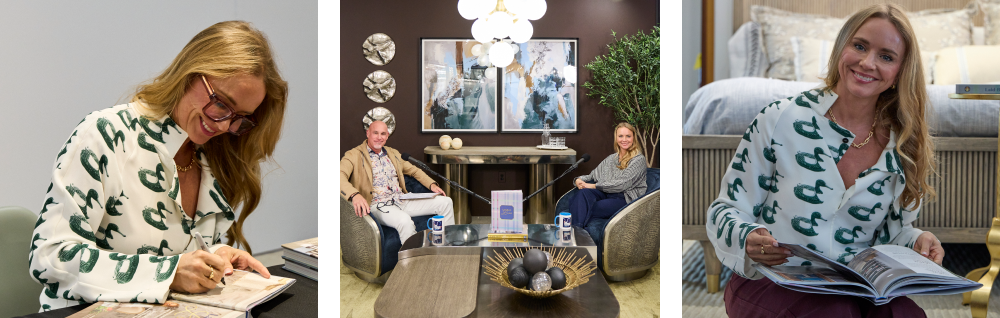
Yes. It's amazing, it's just been so fun. This market's been just so fun. Getting to do my first book signing anywhere would've been exciting, but getting to do my first book signing here at High Point with all of my peers and the people that I look up to and the designers that I look up to in this space altogether getting to do that here feels really remarkable. What's next? I think if I had known that product design was something you could do as a job when I was in college, that is what I would be doing. I can't tell you how much I enjoy product design with my partners. We have so many great partnerships, and I value them as friends and colleagues now, and really look forward to the days that that's what I'm doing.
Jon Pertchik:
What a cool time. I'm so excited for you to have so much behind you and so much in front of you-
Tamara Day:
Thank you.
Jon Pertchik:
... and your son flipping 40 homes in a year and he's just a kid.
Tamara Day:
Crazy.
Jon Pertchik:
How exciting is all of that?
Tamara Day:
It really is. And just watching all my kids. Thomas goes to school next year and we're figuring out where he's going to go, and then Eleanor, a foregone conclusion is that she will be a designer.
Jon Pertchik:
Oh, really?
Tamara Day:
She'll be here with me eventually.
Jon Pertchik:
So does she have some of what your grandmother gave you coursing through her?
Tamara Day:
100%, yes.
Jon Pertchik:
Wow.
Tamara Day:
Actually, I got a text from the moms this week, she showed up for a sleepover Friday night at a friend's house and had done a candy charcuterie board and it was just perfectly laid out. They were like, "She got it from her mama."
Jon Pertchik:
Wow. Well, Tamara Day, thank you so much for being here.
Tamara Day:
Thank you. This was fun.
Jon Pertchik: From Bargain Mansions' sixth season, Laid-Back Luxe and amazing mom. Thank you so much for being here.
Tamara Day:
Thank you. Thank you so much.
Jon Pertchik:
It's been super fun.
Tamara Day:
It's been a blast.
Jon Pertchik:
I'm really grateful, and I wish you the best on the book and everything else.
Tamara Day:
Thank you so much.
Jon Pertchik:
Thank you.
At the core of who Tamara Day is are her Midwestern values, hardworking, willing to take a chance and just push through to whatever end they need to. Tamara's a quintessential example of a person from the Midwest who's achieved great success in a very quiet, humble way. Maybe luck had a role in Tamara's story, but it wasn't the key ingredient. She gave herself permission to experiment, but she was also intentional. She showed up, she put the work in. That's the balance, being open to where things might go while organized enough to actually get there, allowing discovery, but doing the work that makes discovery possible. I'm Jon Pertchik. Thanks for listening. Join us each week as we explore the transformations shaping how we live, work and gather.
Want more conversations like this?
More amazing guests are on deck. Subscribe to stay in the loop.