
EPISODE #114
JOSH & BRENT OF BEEKMAN 1802
How Kindness Built a Brand: The Beekman Boys’ Impossible Journey




“Business isn’t about financial transactions. It’s about relationships.”
That belief is the foundation of Beekman 1802, and a key reason founders Josh Kilmer-Purcell and Dr. Brent Ridge have found lasting success. Their guiding ethos, ‘love thy neighbor,’ may sound simple, but its intent reshaped not only how they built their business, but why it works.
In this episode of The Market Makers, the longtime partners share the unlikely story behind their skin health company. What emerged wasn’t a playbook for chasing trends or capitalizing on hype, but a lesson in resilience, community and kindness.
Kilmer-Purcell and Ridge met online in 1999 — “back when it was still dial-up,” they joked — and built a life together before building a business. Both had left rural childhoods for New York City, climbing the corporate ladder. In 2006, a fateful weekend trip upstate led them to Sharon Springs, New York, where they impulsively bought a farm, and life was never the same.
Shortly after, a neighboring farmer asked if he could bring his 100 goats to graze on their land, and they said yes without hesitation. “That was the original act of kindness that started Beekman 1802,” said Kilmer-Purcell.
Two years later, the recession hit and within 30 days, both men lost their jobs. With a million-dollar mortgage and no income, they turned to the only thing they had left – the goats. “We literally Googled, ‘What can you make with goat milk?’” Ridge recalled. The answer was soap.
What followed became a defining chapter in their story. Early orders were wrapped by neighbors around their dining room table. Volunteers who weren’t paid but showed up anyway. “Our neighbors taught us that business isn’t just financial,” Kilmer-Purcell said. “They came because they wanted to help, and they believed in what we were trying to build.”
That philosophy carried through every stage of growth. When they competed on The Amazing Race, they weren’t chasing the prize money. Their goal was exposure. “We said, if we can make it halfway, we’ve won,” Ridge explained. They ended up winning the season and used the $1 million prize to pay off the farm’s mortgage, so they could continue investing in the business.
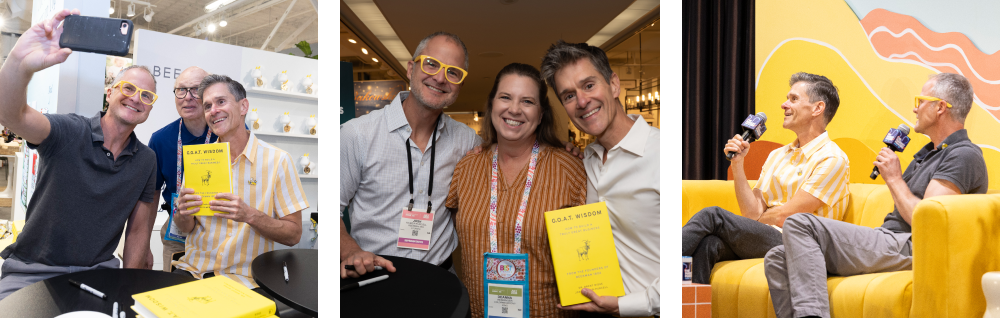
Today, Beekman 1802 is a $150 million company built on what the founders call goat milk and kindness. In their latest book, Goat Wisdom, they reject quick wins in favor of timeless principles. Years later, ‘love thy neighbor’ remains the core of Beekman 1802.
Their advice to entrepreneurs is simple but rare: set a goal, work toward it with integrity and don’t keep moving the goalposts once you get there.
“We built the business we wanted to build,” Kilmer-Purcell said. “And now, we’re content.”
Brent Ridge:
I was desperate. Desperation is the best motivation. When they called, we're like, "Oh, should we do it?" We actually had to think about, "Should we actually do this?" We thought, "There's no way we're going to win, these two middle-aged gay guys." So we said, "Okay, we're not going to win, so let's change our perspective and change the goal."
Jon Pertchik:
The Beekman Boys, Dr. Brent and Josh, are a collision of two incredibly different people with incredibly different histories coming together to achieve greatness. They bought a farm with 100 goats and somehow turned that into this incredibly fast-growing business. And once you get to know them, you start to understand why they're big personalities who bring an intelligence and a thoughtfulness to everything they do. Their story isn't about luck. It's about saying yes to a neighbor's 100 goats and discovering that business isn't just financial transactions, it's about community, resilience, and love thy neighbor. Josh and Brent met online in 1999, back when that was still a novelty.
Josh Kilmer-Purcell:
So we met the old-fashioned way online.
Brent Ridge:
There was still dial up online.
Jon Pertchik:
Dial up online. Rotary phone dial up online.
Josh Kilmer-Purcell:
In 1999, so we were in an AOL chat room and we were just chatting and we were really getting along. And I kept asking him to go out for coffee or go out on a date and he wouldn't. He had never dated a guy before and he was too afraid to go out to meet. So we talked for three, four hours. And I became the world's first internet stalker, because he wouldn't go out with me, but I kept asking him questions. I would say, "Oh, where are you doing your residency?" Oh, Columbia? Oh, how do you get to work? Oh, you walk to work? How long does it take you to walk to work? Which direction do you walk to work?"
So I figured out where he lived through the conversation and then he was getting ready to disconnect and I said, "Tomorrow night, eight o'clock, I'm going to be at this subway stop near your house and you're either going to be there or you're not." And he was and he was standing there.
Brent Ridge:
And we're together ever since, 26 years now.
Jon Pertchik:
That was the beginning of a life together long before there was a business, a farm, goats, or anything resembling a global brand. Maybe just start with, what is Beekman 1802? Just when I say that, what does that mean right now?
Josh Kilmer-Purcell:
Well, we call ourselves a skin health company based on the power of two key ingredients, goat milk and kindness. That's basically what we are today, is a skin health company.
Jon Pertchik:
So tell us, maybe start with the farm and how you even got the idea. What was the conception of Beekman 1802? What was the actual origin thought before it became something?
Josh Kilmer-Purcell:
Well, the conception of the business was desperation.
Jon Pertchik:
That's always a good place to start.
Josh Kilmer-Purcell:
And we'll tell you why.
Brent Ridge:
Well, we were two New York City guys. We were living and working in New York City. I was a physician, my specialty was in longevity and aging. And then I had gone back to business school. And after that, went to work at Martha Stewart and was heading up her health and wellness division, a new division to her company. Josh was working in advertising. This was the early 2000s. I had grown up in rural North Carolina and he had grown up in rural Wisconsin. We had both come to New York City to make our fortunes, and we kind of had. We were in our early 30s and-
Josh Kilmer-Purcell:
We had our career path all set. I was going to be in advertising, work my way up the corporate ladder. He was going to work his way up in Martha Stewart's company. And then in 2006, we were driving in upstate New York. It was a weekend trip in the fall, we were going apple picking and we got lost in this little town called Sharon Springs, New York. And had a nice overnight stay there, we found a hotel, which was really the only operating business in the town. And on our way out of town, the next day, we saw this beautiful farm for sale and we pulled in the driveway and we're like, "This is kind of cool. Maybe we could have this our weekend place." Our friends that are in the Hamptons or in Hudson and we're like, "Well, we'll buy a farm. That'll be cool." And then shortly after we bought it and we cashed in everything we owned to buy it.
Brent Ridge:
And took out a million dollar mortgage.
Josh Kilmer-Purcell:
Yeah, this was 2006.
Brent Ridge:
That's how obnoxious we were back in our early 30s.
Jon Pertchik:
I think it worked out a little bit, but anyway, keep going.
Brent Ridge:
Well, so one weekend we came up and opened up the mailbox and there was a note from a local farmer, Farmer John, and he was losing his farm. And he had a herd of 100 goats and he said, "Hey, I know you guys are from the city. You bought this farm. I grew up in the area on a dairy farm. I'm losing my farm. Could I please bring my goats to your property to graze? Otherwise, I'll have to sell my herd." And so, Josh met with them and said, "You know what? It's fine. Yes, bring them here." It's wonderful, because in our obnoxious minds we're like, "Yeah, we'll come up on the weekends and there'll be a petting zoo and we don't have to do anything for it." But long story short, we say that was the original act of kindness that started Beekman 1802.
Josh Kilmer-Purcell:
So we had no plans of starting our own company, but we took in this farmer. And then in 2008, the Great Recession hit, we both lost our jobs within 30 days of each other and we had no money. We had just taken out this giant mortgage, no money, no way to pay for it. All we had were 80 goats and Farmer John. And so, we literally sat down and Googled, "What can we make with goat milk?" And the first thing that came up was goat milk soap. That's why kindness is an ingredient in everything we make, because it was that first act of kindness before we started a business that helped us start the business.
Jon Pertchik:
Josh, I want to double click on that, because that's interesting to me. When you look back on that moment of saying yes to the goats, I mean, I think the population of the town is 500, you have 100 goats.
Josh Kilmer-Purcell:
Yes. Yeah.
Jon Pertchik:
So that's a bit unusual. People won't just say yes to 100 goats and Farmer John. And yet fast-forward, kindness is a primary ingredient in your success and the success of the brands and the company. When you look back in that moment, why did you say yes? What was it about Farmer John or the goats? Or was it something that you just don't even understand in hindsight?
Brent Ridge:
Well, I think we both, as I said, have grown up in very rural locations, both very faith-based families. And I think it was just always in our being that if someone needs help and you are in a position of helping, you should help. And I think that's how we approached it with Farmer John, who by the way is still living on the farm 16 years later.
Jon Pertchik:
I was going to ask you that. That's what I thought.
Brent Ridge:
But as we talk about in goat wisdom, we talk about a bunch of different proverbs and how they're essential for the foundation of a good business, but the most important one to us is love thy neighbor. And that is chosen very, very specifically. And we still to this day call all of our customers neighbors, because if you look at that particular phrase within the context of religion or outside of religion, every single culture, every single country around the world has something similar in terms of respecting and honoring and loving, not your whole community or the whole world, but the person who is right next door to you, your neighbor.
Jon Pertchik:
Right.
Josh Kilmer-Purcell:
Yeah, it's a very particular word. Even in Islam and Christianity, when you find that proverb, love thy neighbor, and there's different versions, it's always neighbor. It's never love mankind or love the universe or love the world, it's always love your neighbor or those people who cross your path. And so, we both have that background where if we can just help the person next to us and that person helps the person next to them, that's how the world gets taken care of. You can't take care of the entire world, but you can help your neighbor. So I think that's how we were brought up.
Growing up in communities, really strong communities, Wisconsin, North Carolina, then moving to New York City where there wasn't a community. So I think we were missing that idea of community and neighbors. And part of the reason we went back to live in the country was we wanted that sense of community. So when a neighbor is like, "Can you help me?" We're like, "Yeah, let's do it."
Jon Pertchik:
So it was an opportunity maybe unwittingly at the time to sort of express yourself that way and here it has now put you on a new journey.
Josh Kilmer-Purcell:
Exactly. So we started making goat milk soap. One of the first big orders we got was from a store called Anthropologie and they ordered 52,000 bars of soap. We were still making it, soap by hand, wrapping at our dining room table. I was freelancing. I had gone back to the city freelancing and was trying to go back and forth. Brent was trying to fulfill this order and he was wrapping bars of soap and the deadline was rapidly approaching to get it shipped. And he was like, "I can do it. I can do it. I can do it." And I sat in another room and timed him and said, "If you wrap soap 24/7 until next month, you're still not going to hit the deadline." And that was the only way he would believe me. Brent is a complete magical thinker in this world. I am the wet blanket to his magical thinking.
Brent Ridge:
But as a physician and a scientist, I like to have the data. So once he showed me that it took me seven seconds to wrap-
Jon Pertchik:
He confronted you with data. It's undeniable.
Josh Kilmer-Purcell:
You cannot argue with it.
Brent Ridge:
But you have to understand, we were so desperate to get this account, a national account, that we gave them a rock bottom price on the bar of soap. So on each bar of soap, we were making about a nickel. So there was no way that we could afford to hire anybody, otherwise we'd be losing money on every bar of soap. So we also had a little online business that had started and I would go to the post office every day and ship out our orders from the post office, so I got to know the post mistress very well. And so, after Josh gave me that data of seven seconds, I went to the postmistress, I said, "Maria, I need access to anybody in our community who is not working, who's retired, who is a stay-at-home mom, I need access to them." She's like, "I got you covered."
So she basically did a phone tree, called anybody who she knew was stay-at-home. And so, for the next two weeks, 24 hours a day, for seven days straight for two weeks, our dining room was just circulation of neighbors who helped us wrap those bars of soap.
Jon Pertchik:
So you had 50,000 bars wrapped?
Brent Ridge:
Yes.
Josh Kilmer-Purcell:
And we had no money. This was the other thing, we-
Brent Ridge:
I started wrapping. They would just help me finish it.
Jon Pertchik:
You got to 280?
Josh Kilmer-Purcell:
Yeah. And keep in mind, we said to Maria, "We can't pay anybody. We can't pay." And she said, "Doesn't matter. I'll take care of this." And that was our first, one of our first big lessons is that business is not about financial transactions. And to this day, anybody who's familiar with us know that we call our customers neighbors. And the reason we do that is because it was our neighbors who came and wrapped soap around our dining room table with us. They were also our first customers.
So get this, not only did we not pay them to come wrap soap, they would buy soap to take home with them when they were done with work. So it was our neighbors who taught us that business isn't just financial transactions. They came over because they saw we were trying to build something, they wanted community, they wanted to commune with their neighbors, they thought it was fun and then paid us to take soap home. And so, that's why we still call all of our customers neighbors and we teach our team why they call our customers neighbors, why they should do that, because it's that relationship that matters.
Jon Pertchik:
That is amazing. How long between the moment you were getting the idea of the goat milk soap and the Anthropologie account? In other words, were you known in the community? Had you been providing this product to people? Why did this person help you so generously? What was it that brought her to that to help you at that time?
Brent Ridge:
Well, this was about a year and a half in to making the original bars of soap. And when we first moved to Sharon Springs, we were very conscientious of the fact that we were two outsiders into this very conservative, very rural part of upstate New York. And I think Schoharie County is still the most impoverished county in all of New York State. And we wanted to be very conscious of the fact that we didn't want people to say, "Oh, these two city slickers are coming in and they're going to tell us how to do things." And so, we made certain to go and knock on our neighbor's doors and say, "Hey, we're going to start raising chickens. We see you have chickens. Can you teach us?" Or, "We see that you're growing corn. What type of corn grows best here?" Because at the end of the day, everyone wants to be acknowledged for what they have expertise in. And we use that as an inroad into making the connection within our community. And I think people saw that, that we were really in earnest trying to make ourselves a part of this community.
Josh Kilmer-Purcell:
And they also saw how hard we were working to make something happen. So I think a lot of times people think, "Oh, city guys that come in, they had a career, they don't know what real hard work is, right?" But they saw that we lost our jobs. They saw that originally Brent went cold calling in New York City to every department store, major luxury department store, knocking on the doors of them and trying to sell soap to the beauty buyers. He actually got a yes from Henri Bendel, which is a gorgeous store in Manhattan.
So our neighbors saw him get up every day during the Christmas season of 2009, drive three and a half hours to the city, hand sell soap on the floor all day long at Henri Bendel's, get in the truck, drive three and a half hours back, get two hours of sleep, load it up again, go back down. And he did that for an entire holiday season. So I think they also saw that we were really committed to building something. And since the village was down on its luck and needed regrowth, they were like, "Yeah, we see you're willing to put the work in. We're willing to put the work in. "
Jon Pertchik:
Also, I mean a sense of humility too. You have to sort of ask neighbors for help in a very basic way and then watching how hard you're working. I mean, for Dr. Brent, you're a physician, you're on your feet wrapping soap. How do you transition from where you had been? You're obviously a humble and kind person, but still, I'm just curious how you make that transition. Where did the commitment to the goat milk soap come from?
Brent Ridge:
Well, when we first started the company and we started selling it originally on our website, we just started getting these anecdotal reports of people who were like, "This is really helping my skin. It's really changing it." And so, I started researching and the first thing that we learned was that goat milk had the same pH as human skin. So when you cleanse with it, which is the most important part of your skin health routine is how you cleanse your skin, you're not disturbing the barrier of the skin. Now, of course, now every beauty company talks about barrier protection and repairing the barrier. We were talking about that 16 years ago.
And so, I was just really, really passionate from the beginning about helping people, particularly people with very sensitive skin, and also just understanding the science of it, because goat milk has been used for hundreds, if not thousands of years to treat people with sensitive skin issues all around the world. And you can go to almost any country in the world and go to their farmer's market and someone is selling goat milk soap. That's just how universally known it is to treat people with sensitive skin. And I was just fascinated by that.
Going to Henri Bendel, and you're not the first person to say, "Oh, how humble of a physician." I don't know. I was desperate. Desperation is the best motivation. And yes, there is a certain amount of kindness that goes into being a good physician, but also the science. I was intrigued by the science of it. And standing on the floor of Henri Bendel with all these amazing saleswomen, I was probably the only guy on the entire sales floor selling product and just watching them and how they made connection with the customer. And they took me under their wing for sure, because I looked like a deer in headlights, I'm sure, and just said, "Here's how you sell a product." And for me, the motivation of selling the product wasn't about the transaction, it was like, "This product is going to make your skin better." And so, I was just fascinated by it.
Jon Pertchik:
It's purposeful. I mean, it's not a transaction, it's purposeful. And I think there's an authenticity to that.
Josh Kilmer-Purcell:
Unless you're my mother who says, "Well, you fell in love with a doctor and you married a goat farmer."
Jon Pertchik:
Okay, just to recap so far, 2008, both jobs gone within 30 days, a million dollar mortgage, no money, a bunch of goats and Farmer John. They Googled, "What can we make with goat milk?" The answer, soap. They started wrapping bars at their dining room table and Josh started writing about what was really happening, the messy, unsanitized truth.
Josh Kilmer-Purcell:
So I'd written another memoir, yeah, called I'm Not Myself These Days. And then I wrote this one about the farm and I wanted to write... There were so many books out there about professional career people who gave up the city life and moved to the country and found their purpose and meaning and everything was beautiful and butterflies and all that. And I was like, "Boy, it's not like that." And so, rather than the Bubonic Plague, I wrote The Bucolic Plague.
Jon Pertchik:
The country living plague. How cool is that title, right?
Josh Kilmer-Purcell:
Told our whole story about buying the farm and losing our jobs. And the book actually ends before the next big chapter of our life, which was our TV shows. And we were really fortunate after about three or four years in business, that I was interviewing for a marketing job at Discovery Network, a channel called Planet Green, and the president of the network, she's like, "Oh, you're not right for this job at all, but tell me more about this farm that you're trying to do." And she loved the idea of these two gay New York City guys learning how to be goat farmers.
Jon Pertchik:
Your typical day-to-day story.
Josh Kilmer-Purcell:
And she's like, "You're not getting the job, but I'll give you a pilot." And so, we filmed our television show, The Fabulous Beekman Boys, which lasted for two years. And that really told the story of the beginnings of our company and was an amazing marketing tool to help launch us to the next phase.
Brent Ridge:
When they asked us if we wanted to document this transition from city to country life, we were very hesitant because, as I said, we were so committed to being a part of this community and not being seen as the outsiders to the community.
Jon Pertchik:
Right.
Brent Ridge:
And this was the time in reality TV history where they were making fun of country people, like it was Honey Boo Boo or Duck Dynasty or Swamp King. That was kind of the genre that was popular. We told the producers, "We don't want to make that kind of show. If that's the kind of show you're interested in, we don't want to do it." However, if you can make us the butt of every joke and make everyone in our community look like a star, that's the type of show we'd like to make. And it turned out so wonderfully, because the show did make everybody in our community a star. So Maker Deb, Mayor Doug, Farmer John. So when people would come to visit our little store in Sharon Springs and they would see one of the other cast members from the show, it was like they were seeing a celebrity. So it was like they were in Mayberry and they're like, "And there's Andy and there's Barney and there's Aunt B." And they knew everybody's name.
And so, people not just grew to love Beekman 1802, they grew to love this idea of Sharon Springs, New York, and this whole community of people who were working together. And I think that's what Beekman tapped into very early on, is how important community is to build a greatest of all time business. This is how powerful it was. We had our first cookbook come out, because we still to this day raise or grow all of our own food on the farm.
And so, we'd written this cookbook and we were at the Santa Monica Public Library doing a book signing and this older woman, she was probably around 80 or so, very unassuming, had her oxygen tank that she was pulling around behind, she was last in line because she wanted her own private attention with us. And we were just chatting and she said, "Every week my next door neighbor comes over and we watch your show together and it's just our bonding time." And in my mind, I'm like, "Oh, this is so nice, these two older women watching this show together and bonding." And then she added, and she's the president of CBS Reality TV, and I didn't believe her, because it didn't make sense why someone with this high profile of a career would be going to this woman's house to watch our show. And I kind of flippantly said, "Well, if she's such a big fan, why aren't we on The Amazing Race?" And she's like, "I'm going to tell her." And I thought nothing of it.
Josh Kilmer-Purcell:
Yeah, really. And by the time I got home, we got a call from CBS and said, "Do you want to run the race?" And it was again, the power of neighbors. The reason she went over to this woman's house to watch our show, this network executive would go over, was the network executive's husband was dying. He had a terminal illness and she was the caretaker. And in order to take a break from caregiving, she would go to her elderly neighbors and watch our nice, little, kind show about farming. So again, neighbors, neighbors, neighbors. Everybody. Neighbors taking care of each other and that changed our life. We got on the race.
Jon Pertchik:
What made you throw out The Amazing Race? Why did that pop in your head at that time?
Brent Ridge:
Well, she said CBS, and at the time there were two major reality shows on CBS, Survivor and The Amazing Race. And since we were a couple, I just said The Amazing Race. I mean, we had seen this show, but weren't super fans of the show.
Josh Kilmer-Purcell:
You should have said Survivor, then I wouldn't have to do it.
Brent Ridge:
But here's the thing. Then when they called, we're like, "Oh, should we do it?"
Jon Pertchik:
Did you think that was a prank when you got there? You get back and it has aired?
Brent Ridge:
Yeah, but it wouldn't make sense then.
Jon Pertchik:
It's crazy. That's amazing.
Brent Ridge:
So we actually had to think about, "Should we actually do this?" Because we thought, "There's no way we're going to win. These two middle-aged gay guys, we're not going to win The Amazing Race." And so, we said, "Okay, we're not going to win. So let's change our perspective and change the goal. The goal is not to win a million dollars. The goal is to make it halfway. Because if we can make it halfway, we will have maximized the exposure from being on this TV show and maximize the brand."
Josh Kilmer-Purcell:
The real goal was to get another brand commercial out there to 11 million people every week. And so, you don't meet the other teams competing on the race until the race starts. And so, we made a pact and we said we're not going to introduce ourselves to them as Josh and Brent, we're going to introduce ourselves as The Beekman Boys. So then they only knew us and they would only refer to us as the Beekman Boys like, "Oh, watch The Beekman's," because we wanted to get the brand name out there.
Brent Ridge:
We got to the halfway point and we're like, "We've made it." And then we just couldn't lose. We just hung on until the very end. And that's such a good lesson for people who are struggling or you're comparing yourself to what success you see on social media and whatnot, is that you don't always win by just being the best at something or being the smartest or the prettiest or the richest, you win sometimes just by hanging on until the end. And I remember when we crossed the finish line, Phil, who's the host of The Amazing Race said, "How do you think you did it?" And Josh uttered three phrases that kind of became the motto of our company, "Work hard, never quit, and help your neighbor." You have to imagine everybody in our little community every week would go over to someone's house and watch the show, and they also thought there's no way these guys are going to win. And so, the day that was the finale, and you have to keep everything, you sign a contract that you can't reveal anything until it airs on TV.
Josh Kilmer-Purcell:
And we had to be in New York City for the final airing. So all of our neighbors were watching the show at one of our team members' house, one of our employees' house. And when we won, her computer just started like ding, ding, ding, with all the orders that were coming in. And so, it was an amazing opportunity. But I think another full circle moment for us was on our original show, the sort of unspoken plot line of that show was that we needed to make enough money for me to stop freelancing the city and move to the farm full-time and get this business, both of us working full-time. And we always said the goal was a million dollars. We had a million dollar mortgage. If we can just pay this mortgage, I can come to the farm full-time.
Brent Ridge:
Because that was the handicap to the business. You can grow your business, but not if you're also trying to grow and pay off a million dollar mortgage. And so, we thought if we could just pay off the mortgage, then we can really invest in the business.
Josh Kilmer-Purcell:
And what was the prize for The Amazing Race? A million dollars.
Jon Pertchik:
The Bucolic Plague became a New York Times bestseller. Suddenly they had a platform, and that's when Brent decided to write a letter to Martha Stewart, his former boss, who was currently, yes, in federal prison.
Brent Ridge:
Well, as Josh says, I'm an optimist, so I always feel like-
Josh Kilmer-Purcell:
Delusional.
Brent Ridge:
The worst answer you can always get is a no. And no is not that bad, right? It's just a word that points you in a different direction. And so, I was on faculty at Mount Sinai Hospital and my area of expertise is longevity and aging. And I had gone back to business school, and after business school, I'd went back to work at Mount Sinai and there had been this long-
Jon Pertchik:
You're a physician with an MBA also.
Brent Ridge:
Yes. And my long-
Jon Pertchik:
Had to catch that. He kind of skipped over that a little bit. Pretty impressive.
Brent Ridge:
This long dormant project of creating a center for the study of aging and the care of older people had been in the works at Mount Sinai, but most physicians aren't very strategic in terms of their thinking. And so, they had never been able to raise the money or just really get this idea off the ground. And so, when I finished business school and went back to Mount Sinai, they said, "Oh, we're going to give you this project." And I said, "Okay." And so, I thought, "Well, there are a lot of people in New York City who would want their name on a building at Mount Sinai. But before I go out and solicit a donor, I should have a beautiful design for this building."
And so, first I made a list of all of the star architects, like name brand architects that I could think of, and I. M. Pei was on the list. And for those of you who don't know, he's one of the most famous architects in the world, designed the pyramids at the Louvre, just very prominent architect. At the time, he was in his 80s and still working. And so, I wrote him a letter and said, "It's very important in every aspect of this center that we demonstrate that just because you're getting older doesn't mean you're going to lose your productivity or lose your vitality. We want to show it in action."
And so, pop the letter in the mail and a few days later came out from seeing a patient and my secretary said, "There's a Mr. Pei on the phone to talk to you." And it was him. And he said, "You know what? My son had just designed the medical center at UCSF and I would love to work on this project." And so, they came up with this beautiful design. And then I sat down and made a short list of who could not only donate this money, but could also represent productivity as you get older.
Now, Martha at the time was 65, I believe, and also had just gone to prison, so was in need of image rehabilitation anyway. And I had gotten the address for Alderson from a satire essay that was in New York Magazine talking about how much fan mail Martha was getting in prison. And at the end of the essay, it said, "Federal prisoner number, blah, blah, blah, blah, Alderson, West Virginia." And I used that address. And I said, "Okay, if she's getting all this mail, how am I going to make my letter stand out?" And in the letter I had told her, I said, "You rose to prominence for the baby boomers when they were in their nesting phase and creating the best home environment was the most important part to your life."
Josh Kilmer-Purcell:
So they created this whole business plan for her.
Brent Ridge:
About how she could educate baby boomers on living a healthier life as you get older.
Josh Kilmer-Purcell:
And then he was like, "How is she going to notice it with all her mail?" So he put it in a big confidential X-ray envelope from Mount Sinai Hospital, giant, handed it to me, and he's like, "Mail this to Martha Stewart." And so, we put stamps on it and two weeks later he got a call from her secretary saying, "Martha loves this idea and wants to meet as soon as she's available."
Jon Pertchik:
So we'll come back to the scheduling of that in a second. There's a lot to unpack there. I mean, one of the lessons there is aim high, right? I. M. Pei, Martha Stewart. Another is the creativity to even devise this plan of how do we, I don't mean this in a bad way, but spoonfeed her a story, a narrative that can help that rehabilitation.
Brent Ridge:
Well, and it was a purpose too. I mean, I was so passionate about wanting to get this center built, because I believe that we can teach people to age in a better way. And so, I think that passion came through in the proposal. And the same thing with our company now, we don't even see ourselves so much of, I mean our CEO is going to not like me saying this, as a skin health company, we see ourselves as a kindness company. And our purpose is how much kindness can we put out into the world? And by virtue of that, we'll find our people and they're going to buy our product. But it was the same thing then. The purpose is educating people about how to live a healthier, longer life.
Josh Kilmer-Purcell:
But to your point about creating the business plan for Martha, not just saying, "Can you donate money?"
Jon Pertchik:
Which is what nine out of 10 people would have probably just gone on autopilot to have done.
Josh Kilmer-Purcell:
"I. M. Pei, we don't just want you to design this. We want you to show how an aging person still contributes to society." We wrote about this in the book too, about our whole reason for being is kindness and creating that win-win situation. So whenever you're doing any negotiation or any transaction, just making it easy for that person to say yes. Doing all the work for them to get them to say yes, create that business plan that they can just sign off on.
Jon Pertchik:
I mean, the purposefulness and the passion is one thing, but then to really use everything within you to be creative to say, "My target of whatever it is we're attempting to achieve, what are the things that really matter to them?" And then design your plan around that. To pause. And many people will just go, there's an objective and they go after that objective. Instead of taking a breath, if they really care enough about it to pause, think about the purposefulness of it for that person, and then design a plan around that.
Josh Kilmer-Purcell:
That's an easier path to yes than negotiating with opposite intents.
Jon Pertchik:
Right.
Brent Ridge:
Well, and I think we enter every negotiation like that, not with what is in it for us, but what's in it for you. And by virtue of us delivering for you, we're going to get what we need out of it as well. And it reminds me of one of the biggest collaborations that we've done as a company was with this little show called Schitt's Creek. We were big fans of the show. It had launched on this tiny network called Pop TV, and we were such big fans of it because it was kind of our story, these city slicker outsiders moving to this little town of eccentric people, but everyone accepting one another.
Josh Kilmer-Purcell:
But we were always upset, because we would tell our friends about it and they're like, "I haven't heard of it." Because it was on this tiny little network called Pop TV.
Brent Ridge:
Well, they announced that they were going to do their final season.
Josh Kilmer-Purcell:
And we reached out and we're like, "Let us help you, see if we can get the word out about your show a little bit. And well, let's do a collaboration. If anybody watches the show, there was the Rose Apothecary was the brand that they had." So we're like, "Let us create a Rose Apothecary brand and we'll do a collab. It's going to get the word out about your show." Then they were like, "Oh, yes, thank you, thank you." Literally right after that, the pandemic hit, they got picked up by Netflix. And so, they exploded. You remember how big it got? And by then we were already attached to them. We were doing a collab, one we never would've gotten if we had tried to approach them or approach Netflix and do a collab, it would've been too expensive.
Brent Ridge:
And we didn't even think about doing the collaboration to make money for ourselves. We're like, "You have created such a good piece of content. We want more people to see it."
Josh Kilmer-Purcell:
And it wound up being our most profitable-
Brent Ridge:
Our most profitable collaboration ever. But here's another wonderful moment in that whole story around Schitt's Creek, is that when that product line came out, we said, "You know what? It's going to be so fun if we completely change our flagship store, which is on Main Street in Sharon Springs, and make it look like the Rose Apothecary." So we completely skinned it.
Josh Kilmer-Purcell:
We took our name off the store, took the signs down and just made it Rose Apothecary, just like the show.
Brent Ridge:
And it got a lot of publicity and people came from all over the world to see the Rose Apothecary, as far away as Australia.
Josh Kilmer-Purcell:
They acted out their favorite scenes. They dressed up as their characters.
Brent Ridge:
But here's what's amazing. This was in January, right before the world shut down in February. And that collaboration and that Rose Apothecary pop-up brought so much money into our little village that our other little... Our main street is half a mile long. So all of the other little businesses on our main street got the spinoff of all of those people coming into our town and that helped them survive the pandemic. And all because we wanted to help more people see Schitt's Creek.
Jon Pertchik:
Well, you guys really are good neighbors. The little town of 500 is becoming UAE. I mean, it's really benefiting them, maybe not that far, but that's amazing. So right now I want to make sure we can cover your current book, which you touched on a little bit. Maybe just share a little bit about the genesis of that. Where did the thought process come from? What's the origin story for that particular book and where you're heading? I want to talk a little bit about the future too.
Josh Kilmer-Purcell:
Yeah, so for a lot of years people said, "You're an overnight success. You got started on the farm and got huge." So we were often asked, "How did we do it? How did we do it? What's our story?" And one of the things we realized is that there's a lot of entrepreneurial media out there that's very trendy or faddish. It's like, "The secret thing you're not doing in order to get a nine figure business overnight." And that's where the state of entrepreneurialism is in America today. And we didn't build our company like that. We didn't build it based on secret methods or day trading, this, that. We did it based on the things our parents and our grandparents taught us. And so, what we did was pick 12 proverbs that we all know, not religious proverb, maxims, and we showed things like, make hay while the sun shines, or you can take a horse to water, but you can't make a drink, or an empty vessel makes the most noise.
And we said, "These things are things we've known for millions of years are true. They work, but we haven't thought about how they're applied to business or today's contemporary business." So we took each of these proverbs, applied it to a section of our business and said, "This is how you build a real solid greatest of all time business, not the latest fad on YouTube."
Jon Pertchik:
I think so many people across the board, there's this mindset of, "How do I get there quick? Is there a shortcut?" And there is really no shortcut. It's hard work and it's these maxims or principles that have been around for a long time and they're durable.
Josh Kilmer-Purcell:
And we know in our gut that they're true.
Jon Pertchik:
That's right.
Josh Kilmer-Purcell:
We just might not know how to apply them or the world is telling us that that doesn't matter anymore, and it does. We always say that's the Shark Tankification of America. And we love Shark Tank. It's a fun show. It's great. But now every entrepreneur thinks that if they want to start a widget business, the first thing they have to do is go out and find someone to give them $5 million. And we say, "If you're going out and finding $5 million, you're not starting a widget business, you're starting a fundraising business. And then your entire business just becomes fundraising and fundraising and fundraising."
Since we launched our company out of a debt crisis, we were really allergic to debt for the first 15 years. We were like, "We're not taking on debt." And that was great, because we actually proved that our business was profitable from day one, it was scalable, it was growing, it was succeeding, and then we were able to get much better investment when we finally went out.
Brent Ridge:
And the book is called G.O.A.T. Wisdom, Greatest of All Time Wisdom, because it is using these old proverbs and these old maxims that still have so much power today. And I think it's so critical in this day and age when we are bombarded with so much information. You turn on your phone, a thousand things are coming at you. You walk down the street, a thousand things are coming at you. We have an overload of information, but a severe lack of wisdom. And that's one of the goals that we hope that the book will accomplish by the time you get to the end of it, that no matter whether you're an entrepreneur starting your business or you're just trying to figure out how to make your life better, that we are teaching you how to take the information that you have available to you and turn it into true wisdom that will make your life great.
There's too much emphasis in the media about billionaires and tech entrepreneurs and influencers on private jets. And we think that there is a need for more success, mainstream business success stories. There are millions of small businesses. Through the backbone of the American economy, we want to encourage those types of businesses.
Jon Pertchik:
That's amazing. Well, I'm glad you've created that and given that gift to everybody. Where do you go from here? I mean, obviously right in front of you is that book and making sure it gets out there. Anything you can share that you might be working on that people may not be aware of?
Josh Kilmer-Purcell:
Everybody starting out in business or having any goal in life, you have to set that goal and stick to it. And our goal was to build this successful business based on kindness that would outlast us. And we feel like we have built that business. We have an amazing team. We love to go out and do things like this. We love to go spread kindness. We go to kindness conventions and researching. And that is our goal and we've reached it and we're happy. So part of our message is that if you set the goal and your content, don't keep moving the goalpost. Maybe something else will come up for us, that we'll get crazy passion about some other direction, but for now we've accomplished what we want to accomplish. Now we just want to keep spreading the news and spreading the kindness of it all.
Jon Pertchik:
I love that. I think human beings do that to ourselves too. We're never-
Josh Kilmer-Purcell:
It's American.
Jon Pertchik:
We're never happy. It's right. It's a treadmill.
Josh Kilmer-Purcell:
Yes.
Jon Pertchik:
And so, just be happy where you are and what you've achieved and see what the world brings along. Well, Dr. Dr. Brent Ridge, Josh Kilmer-Purcell, thank you so much for being here.
Josh Kilmer-Purcell:
Thank you.
Jon Pertchik:
Love thy neighbor, it's a simple message, but it's a reasonable ask. And in practice, it's effective because it means showing up for people in real life, not someone on the other side of the globe or hypothetical, but right down the block, down the street. Josh and Brent said yes to Farmer John's 100 goats. Their neighbors showed up to wrap 52,000 bars of soap, and from that foundation of kindness, they built $150 million company. Their advice, don't move the goalposts, set your goal, accomplishment, and then ask yourself, "Am I content? Did you do what you set out to do?" The Beekman Boys built a business that will outlast them based on goat milk and kindness and they're happy. I'd call that a major success. I'm Jon Pertchick. Thanks for listening. Join us each week as we explore the transformations shaping how we live, work, and gather.
Want more conversations like this?
More amazing guests are on deck. Subscribe to stay in the loop.