
EPISODE #115
RASHEEDA GRAY
Rasheeda Gray on Refusing to Choose Between Creativity and Strategy




On this episode of The Market Makers, Jon Pertchik sits down with Rasheeda Gray, founder of Gray Space Interiors, for a conversation that redefines what it means to be both creative and strategic. The takeaway? What if the secret to building a successful design firm wasn’t choosing between one or the other? What if there’s a way to have both? Finding common ground propelled Gray forward, giving her the chance to take calculated risks with great reward.
Her path wasn’t straightforward, and by no means linear. Instead of pursuing interior design right away, she earned a degree in marketing, which helped her rise to assistant vice president at Chubb. For three and a half years, Rasheeda worked a 9-to-5 corporate job, raised two young children and built her design firm between 9 p.m. and 2 a.m. It wasn’t about hustle culture. For her, it was about pursuing her passion. She needed proof that her creative passion could responsibly replace her corporate salary. So she hedged, planned and eventually executed, launching her business in 2017.
Today, Rasheeda is known for her thorough approach to design, including a detailed client questionnaire that translates emotion into environment. She asks about favorite vacations, music, even the feeling clients want when they walk into a room. “Luxury is a feeling,” she explains. Her ability to convert abstract emotion into tangible design decisions is equal parts intuition and strategy. The answers become the blueprint—not just for a room, but for an experience.
Another turning point for Gray was High Point Market. Attending High Point for the first time in 2017 opened her eyes to the power of networking, education, and resale. It wasn’t just inspiration; it was the importance of building a grounded infrastructure for her business. She learned how to sell furnishings profitably, position her brand intentionally and connect with mentors like Cheryl Luckett, who helped accelerate her growth.
Today, roughly 75% of Gray Space Interiors’ projects include construction led by her husband, a licensed general contractor. Together, they’ve built a vertically integrated design-build firm grounded in trust, family values and shared vision.
So what’s next for Rasheeda? Plenty is on the horizon, spanning product licensing, television, even expanding Gray Space into a high-end residential and boutique commercial powerhouse.
Her biggest takeaway? Strategy doesn’t stifle creativity, it safeguards it. Once you stop choosing between the two, that’s when real growth begins.
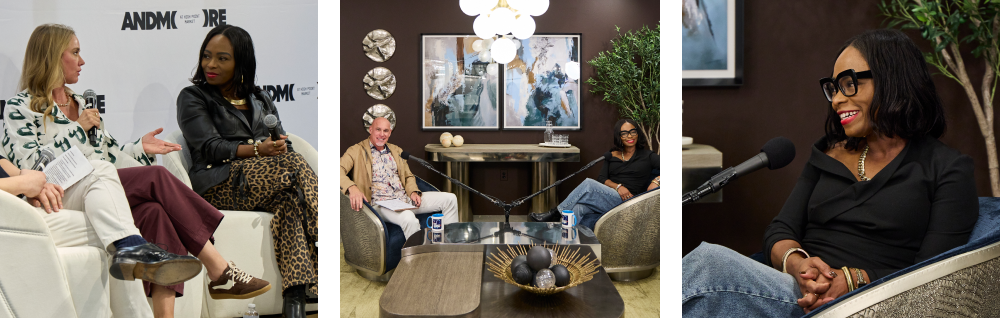
Jon:
I am here today with Rasheeda Gray of Gray Space Interiors and Designs, and I'm so excited to be with you.
Rasheeda:
Thank you again for having me.
Jon:
There's so many things I want to get to and maybe to warm up something. I read a quote from you that I love and maybe a good way to get started is, "Lighting is the jewelry of space." I love that.
Rasheeda:
Yeah.
Jon:
Where did that come from? Tell me a little bit about that.
Rasheeda:
I realized that lighting is imperative in any space and it takes a space from being sort of your every day to giving it so much personality. It really can make or break a space. And lighting is layered. The layering of lighting is what makes a space really special, just like you would do jewelry. So yeah, I just think it takes the space from ordinary to extraordinary.
Jon:
Well, tell me a little bit about that and how you layer that into your designs, how you think about that.
Rasheeda:
Yeah. When we're working with our clients, we have an extensive questionnaire where we're asking things like, what do you want the space to feel like? What's your favorite place to vacation? Is there a hotel that inspires you? What's your favorite type of music? All of those things play into which lighting pieces we're going to select.
Jon:
Today on the Market Makers, Rasheeda Gray, four years, three jobs and two kids, I'm not sure if I can do the math on that, but Rasheeda's story is incredible. It's about juggling, it's about multitasking, it's about hard work. Her superpower may be about both hemispheres of her brain operating at high levels. She's creative, yet she's passionate, organized, and driven. Rasheeda can talk about KPIs and pillow colors. Her story is about refusing to choose between creative and strategic, why can't it be both?
Rasheeda:
I think I understood early on my background is in marketing and I understand that when the people are requesting or wanting something, they may not have the words to describe it, and so you really want to get into the emotion connected to that want. I just heard a designer mention this Michel Boyd, and he said, "Luxury is a feeling. It's not a tangible thing, it's a feeling." And so we ask these questions to evoke emotion so that we can understand, okay, yes, their favorite type of music is jazz, it's relaxing, it's a glass of wine at the end of the day. We have to layer in lighting that provides that sort of environment.
Jon:
So you'll take them and you have this questionnaire of sorts, right?
Rasheeda:
Yep. Yep.
Jon:
I mean that's what I understand. You just shared some of it. So you're effectively converting questions that maybe to you very much have to do with design because they have to do with feeling and how people sense things. So the person responding, probably if some of them are a little confused, maybe, where did you come up with that? I mean, at what point did you develop sort of a formal questionnaire to help elicit and then to get you to have a chance to interpret who this person is and what kind of experience they want to create?
Rasheeda:
I am an entrepreneur at heart, and so business almost sort of comes first. Of course, I got into the world of design because I love the industry and aesthetics, and there was somewhat of a talent there. It wasn't until maybe a couple of years in that I realized how valuable the questionnaire was and how you can use it to really bring a client's vision to life. And so I tweak it all of the time. At least once a year I'm saying, what can we add? What can we change so that we can best understand the client?
Jon:
One of the things I love about implicit and what you just said, you're talking about a process and continuing to improve, and you're also talking about a curiosity. I imagine you're probably thinking of yourself a little bit as a lifelong student perhaps.
Rasheeda:
Yes.
Jon:
I mean, tell me a little bit about how you first started to have this awareness that you have this natural curiosity, a natural sort of inkling to learn and to continue to improve.
Rasheeda:
Maybe I'm a little bit of a Zodiac girl, so that's part of my nature as a Gemini. I just feel like I'm always curious, but I think someone gave me permission to be curious early on. And also someone else said something that stayed with me. So early in grade school someone said, "The best students ask questions." If you don't understand something, you want to make sure that you're asking about it. And then also the most intelligent students ask questions. So I've just never been shy to ask questions. And then I think it's magic and how we translate what we've learned about a person into their home. I don't know. It just started as a child early on.
Jon:
Well, and tell me about that. Where did you grow up? Siblings? Big town? Little town?
Rasheeda:
So I like to say that I am a city girl with a southern heart. So I say that because I grew up in Philadelphia and in Fayetteville, North Carolina. Oh, okay. So my mother's from Philadelphia, my father's from Fayetteville. So I have both of that dynamic in my family. I am one of three girls. I'm the oldest. I have a lot of oldest sibling traits and personality traits. I always knew I was a creative and early on I would try to paint, I would redecorate my room. I have in my home a stuffed animal that I converted when I was 12, I converted into a teddy bear book bag. That was all the rage in the '90s. All the girls had it, and for whatever reason, maybe my family just couldn't purchase it at the time, and so I made it myself. I'm so glad my parents kept that all these years.
Jon:
They still have it?
Rasheeda:
Yes, they still have it.
Jon:
Oh my goodness, how amazing is that?
Rasheeda:
They gave it to me about 10 years ago, and so it's hanging in my guest room, which also doubles as my she cave, my meditation room, and it's there to remind me that I can do anything. Anyone can do anything. And even as a 12-year-old little girl I was exploring creativity in different ways. So that evolved into sewing, painting. I went to college for marketing, and that was because I knew I was creative, but also had a responsibility because I was the first in my family to go to a four-year college that I need to have a major that made money. And so I landed in what's creative, but also it's business. I think it makes money, and that's how I got into marketing.
Jon:
We hit pause on that. Something you said I want to just play back slightly. The entrepreneur who can be organized and driven in a structured way, but have the ability to see this stuffed animal and make it into something different. It takes a special person to have those things coexist.
Rasheeda:
It's a struggle.
Jon:
Tell me about that, those two things coexisting in your brain.
Rasheeda:
It is very much a struggle, and early on I sort of suppressed the creative side.
Jon:
Why do you think?
Rasheeda:
It wasn't a part of my environment?
Jon:
Okay.
Rasheeda:
Creativity was just not in my household. Now, my husband, on the other hand, my mother-in-law is an author and a poet, everyone has a beautiful talent on their side of the family and they were given the space to explore it. And nothing negative towards my family, it's just I'm probably one of the few that explored creativity and just wasn't something that was practiced in our household. But I did find ways to express it outside, and so my parents did allow me to rearrange my room a trillion and one times and make skirts and dresses and things like that. So I found my way, but it just wasn't ... I always thought, you can't make a living being creative.
Jon:
Oh. Okay, I got it. So you grew up in a household where maybe entrepreneurship or hard work in a traditional business sense is what was not rewarded, but maybe desirable. So you naturally went down that path, but at some point, maybe with the benefit of hindsight, you look back and you start to see the stuffed animal story, the creativity coming out. Eventually it was going to come out whether you wanted it to or not.
Rasheeda:
I truly believe every single thing happens for a reason. My journey happened the way it did because I am intended to be where I am today. And when I started in this business 10 years ago, I sort of thought that because I didn't have formal training it was a disadvantage. I quickly found out that the grass is always greener on the other side, and being in marketing really gave me a competitive advantage. So I spent 15 years in marketing for insurance and financial services companies. My last role was assistant vice president of marketing and business development for Chubb Insurance, and taking that business mindset, having KPIs for my business, being very strategic in my planning, marketing initiatives come easy to me. So I'm grateful for my path, although it wasn't direct.
Jon:
Her path wasn't direct, but it equipped her for what came next. The question whether Rasheeda would become a designer, the question was how. And her strategic side, the one she'd been fine tuning for 15 years of a corporate career was exactly what she needed to launch the creative side. So she hedged for three and a half years.
Your transition was interesting to me. I mean, maybe share a little bit about that.
Rasheeda:
Yeah, I'm not a risk taker.
Jon:
Well, you are and you're not. You like to hedge and mitigate, I think.
Rasheeda:
Yes. There you go. I'm a calculator risk taker. And so I sort of took that approach as I shifted from marketing to interior design, I spent three and a half years doing both. So I was in my daytime corporate job from 9:00 to 5:00. I had young children at the time, and so I would be mom and wife from 5:00 or 6:00 to 9:00, and then from 9:00 to 1:00 or 2:00 AM I was building Gray Space Interiors, and I did that for three and a half years until I said something has to give.
Jon:
Yeah, don't move off of that for a minute because that's amazing. I mean, to be a mom is a full-time job.
Rasheeda:
Yeah, it is.
Jon:
Especially with little ones. It's like a double full-time job. Then you've got your, quote-unquote, 9:00 to 5:00 and then you have your project that's becoming your future.
Rasheeda:
Yes.
Jon:
Tell me about juggling that. I mean, really when you bring yourself back there and you kind of close your eyes and bring yourself back there, did it feel stressful? How did you manage through that?
Rasheeda:
That's a good question. I look back and say, how the heck did I do it? But I also remembered the advice of a close friend of mine who was also a creative entrepreneur, and she said, "Rasheeda, your creativity, your passion will fuel you. It will give you the energy that you need to push through." I also know it's not sustainable to be sort of working those sort of hours. So I don't ever want to promote hustle, hustle, hustle because you're burnt out, you're not giving your best self to any one thing. And people always ask about balance, and I say, there's no such thing as balance. It just does not happen.
So at that time, I was probably a lot imbalance. I was a terrible employee. Those last three years I probably wasn't the best employee, but I think I had to do it that way. I had to prove to myself and to my family because I had a responsibility fiscally to my family that I could replace my corporate salary and this transition not be a financial burden to our home.
Jon:
This is sort of like a duh moment when I say this, but it's worth people sort of us pausing and saying this. There's a little bit of luck involved in anything, but boy, the harder I work, the luckier I get.
Rasheeda:
True.
Jon:
I mean, you can't skip over the hard work and what you sacrifice during that time. I mean, speak to that.
Rasheeda:
Yeah. Yeah. My children were young and I would try to take them with me to work as much as possible because if I'm working a 9:00 to 5:00, then my weekends are spent the business. So I would go from soccer practice with my son and say, "Hey, mom has to go over to a client's house to grab measurements really quickly. Just put your iPad on and it'll be quick." There was a lot of that, and I wasn't shy with our clients about that. And my mother, they'll be well behaved, they just need to be here for the hour. I think that was just a part of me sharing who I am as well and attracted those same clients that value family.
But yeah, it was a juggling act for sure, and thank goodness I have an amazing partner who just happens to be my general contractor.
Jon:
Right. I want to get to that too. I'm looking forward to talking about that.
Rasheeda:
Yeah, so my husband has been an entrepreneur for a while. He owns a franchise insurance agency in addition to being a general contractor. He's been super supportive along the way because he firsthand knows what it takes to build a business.
Jon:
I really want to get into that. Maybe just speak to the evolution of that and how does that go? What are some of the challenges there?
Rasheeda:
It's amazing. I love my husband. No. No, it's actually a really great partnership. I'm grateful that he has the talent and the skill to have a successful construction company. He always had a honey-do list. I'm exploring this creativity, and so our first home we're redoing things and rebuilding and DIYing and all those things, and that was before I became a designer and started the business. And he would just gain skill, gain skill. His uncle was a master plumber, and so he sat under his tutelage for a little while. He loves to do construction work.
We've been married for 18 years, we're college sweethearts. I always pulled them into my projects. And as I was building the design firm, because we live in the northeast part of the country, there was quite a few renovation projects that was a part of our pipeline. It's just natural. And I would connect with contractors, we would work together on projects, and sometimes it went well. But a lot of times there was a hiccup in the road. I couldn't find the right contractor partners. Fast forward, my husband and I in the background, we would do small real estate deals personally on our own, and he would be the one who would solicit all the subs without a general contractor's license.
And so fast forward, I was like, "Jake, I don't think I'm going to do construction anymore because I can't rely on amazing contractors to be at the level that we need for our clients." And he was like, "Well, wait. I have the contacts and the insurance business, I can't do anything in the field right now. It's just in the background during COVID. I'll get my license." So he became a general contractor in 2020, and now 75% of our projects involve his team. He does not take projects on without us, but I do take on furnishing projects without renovation. It works really well. There's no one I trust more in the world.
Jon:
Sure.
Rasheeda was building Gray Space Interiors from scratch while keeping the corporate salary. But there was a problem, she had no formal design training, no industry connections, no idea how this world actually worked. So she reached out, found a designer who made the same transition a few years earlier.
Rasheeda:
So I found another designer who was in the same position that I was in, but a few years ahead. That's Cheryl Luckett. And so I sent her a direct message, did not think she was going to respond, and she did. She was like, "That was the most professional direct message I ever got in my entire life." So yeah, she and I formally mentored for two years or so, but we're now I'm friends. That's my girl. I quickly realized my first High Point market was 2017, and I left saying, these are my people. This is where I should be. I was like, okay. As much as I'm receiving from mentorship, I can give back to others.
Jon:
So let's speak to market for a second. We're sitting here at High Point right now. Tell me a little bit about. Was '17 your first market experience?
Rasheeda:
Yep.
Jon:
You started your business at '16, I think. Am I right about that?
Rasheeda:
I started in '16. I went to my first market, I think spring of '17, and I'm sure it was after I connected with Cheryl and she encouraged me to, and maybe I was a little intimidated and didn't think I could go to market, and so she scooped me under her wing and introduced me to everyone she knew. And that was when my mindset changed and shifted and it was a game changer for my business just in terms of profitability and things like that.
Jon:
Why? What about market, that first one for you, you've got this person helping you deal with the intimidation factor, these big buildings and things everywhere.
Rasheeda:
Lots of people.
Jon:
How did that convert to profitability? Tell me that bridge.
Rasheeda:
Yeah, I realized I need to get a resale certificate and I needed to sell furniture not only for profit, but that will allow me to provide quality products to my clients and things that are different than what they can purchase themselves. So the business side of things, and then the networking side of things and the education, sitting on a few panels, learning more about my business. I discovered a few podcasts because of High Point, and those podcasts helped me to grow my business. And then the networking, everyone's here.
Jon:
I mean, how much of this helps you, inspires you for the next, the customer you don't yet have for next year, and how much of that sort of call a trend getting in front of the trend, frankly, being a part of the creation of the trend?
Rasheeda:
I really am keeping my pulse on what's happening in our industry when I'm at market, and even when I'm marketing outside of market, I'm marketing for the next client. You know how they say dress for the job that you want, not the job you have?
Jon:
Right. Yes.
Rasheeda:
I just really want to be intentional about what my brand shows up as and while also educating as well so that I can be positioned as the expert. I think I really try to take a step back before market happens and I say, where's my business at right now?
Jon:
You seem equal parts of serious hardcore business person with badass creative. You're this weird inflection point.
Rasheeda:
It's a battle because sometimes I want to be more creative and I'm like, oh, I'm not there. And sometimes I want to be more strategic. So it's always a struggle. The balance is always happening.
Jon:
So how do you manage that yin-yang of you, of Rasheeda, like this pull and push of business, creative? How does that work?
Rasheeda:
I got to hire the right people. I mean, I still have my hand in a lot of the designing for our firm, but I do look to hire folks who are actually much more experts in areas where I'm not that great. Where I'm weak I'm hiring for someone to be strong in those areas. And so I have accepted that I may never learn CAD, and at first I was like, oh, does that make me less of a designer? But now I understand I'm one person, I can't do everything and so let's leave that to an expert who can.
Jon:
That's another such a big takeaway for folks I think, is having the self-awareness to do what you just said just. Before you can even ask yourself those questions you have to have the self-awareness to understand that we have strengths and weaknesses. Well, you've accomplished so much in the design part of your life has been relatively short. We're talking, it's coming on 10 years, actually, we've got a big anniversary coming up.
Rasheeda:
Yes.
Jon:
What is next for you? Do you have long-term goals that you're really aiming for? If you're willing to share any of that. And even if you want to tell the long-term goals, what's sort of next? What do you see in the next year, two, three? 10th anniversary coming up, what do the next 10 look like?
Rasheeda:
I love to share things like this because I believe in the power of manifestation and speaking things into life and so sometimes I get a little nervous about saying things out loud. But I selected the name Gray Space Interiors for my firm because I've always realized that I want it to be a brand. And so I want our firm to evolve into a continuous high-end residential and boutique commercial design firm, but I would also love product licensing and to have the Gray Space brand sort of land in that arena as well. I have a lot of great ideas up here, and so I can't wait to get those down in front of the right manufacturers.
And then lastly, television. That was not on my radar in the beginning of the business until I got a DM one day from a casting director, and once I did the first show, I was like, whoa, I really, really enjoy this for many reasons, and I think it's something that I should continue to add in. So those three components are kind of what I'm looking at for the future.
Jon:
Wow. So you don't have enough on your plate to juggle the five or six things.
Rasheeda:
I know, right?
Jon:
Wow. Well, Rasheeda Gray from Gray Space Interiors, thank you so much for joining me today.
Rasheeda:
Thank you.
Jon:
It's been amazing and you really are very unique in your perspective, and I just really have enjoyed meeting somebody. You can balance, frankly, the two hemispheres of the brain that often don't communicate with one another for most people, which is really extraordinary. So thank you so much for being here today, and joining me.
Rasheeda:
Thank you so much for having me. This has been great.
Jon:
Here's what Rasheeda figured out. Being strategic doesn't kill creativity. To the contrary, it protects it. And guess what? That's her competitive advantage. She's not just designing beautiful spaces, she's building a brand that can do product licensing, land TV deals, and operate at the high end. You don't have to choose between creative and strategic use. One to build the other.
A few of the takeaways that are critical to her success. One, humility. Two, mentorship. And putting those together, having the courage and the humility to ask somebody who's ahead of you in their development and their growth and their success for help. A lot of folks are afraid to ask for help. That, again, is a big part of the journey she's been on to where she's gotten to today.
I'm Jon Pertchik. Thanks for listening to the Market Makers, where we explore the transformations shaping how we live, work, and gather.
Want more conversations like this?
More amazing guests are on deck. Subscribe to stay in the loop.