
EPISODE #121
AMBER GUYTON
Soulful Maximalism and Listening to Your Mom




"I look at spaces as opportunities. This is a canvas that I want to paint. There should be no space that's not decorated."
That statement captures the essence of Amber Guyton, founder of Blessed Little Bungalow, maximalist by design, and one of those rare people who is equally creative and driven. She just needed someone to ask the right question before those two worlds collided.
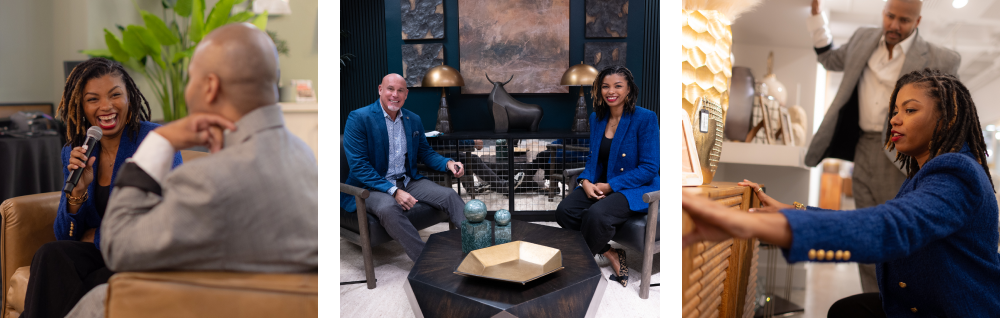
In this episode of The Market Makers, Guyton sits down with Jon Pertchik to talk about growing up in a blink-and-you'll-miss-it town in South Carolina, two corporate careers that never quite fit, and the moment her mom asked her a simple question that changed the course of everything.
Guyton grew up in Pineville, South Carolina, but even in her small town she was always redecorating her room, channeling her creativity at a young age. "I loved changing my space," she said. She'd paint the football banners every Friday, do hair and eyebrows on the side, and dream about writing for the New York Times or Essence. The creative drive was always there. The path just wasn't obvious yet.
She graduated college during the 2008 recession, pivoted from journalism to advertising, earned her MBA, and began climbing corporate marketing roles — USAA in San Antonio, then tech in San Francisco. She was chasing success and succeeding. But it wasn't until she bought a house in San Antonio, moved in on closing day, and had the entire thing decorated within a week that something clicked. When her mom walked in and saw Amber’s work come to life, she asked the question that pivoted the course of Amber’s life: "So when are you going to do this for real?"
"It was the turning point," Amber said. "The aha moment." She gave herself 90 days and launched Blessed Little Bungalow — first as a blog, then as a side hustle and it soon became her full-time business. Her first client project was a friend's nursery she refused to be paid for. Her first paying stranger found her through a Facebook group of San Antonio moms. Client by client, she was building something real on nights and weekends, finding her stride along the way.
What makes Amber's work distinct is the philosophy behind it. She calls it soulful maximalism — intentional, joyful, and layered with meaning. Every corner is considered, and color is not just a decoration, but a point of view. She never stopped creating, not through two cities, two careers, or a pandemic. Her mom saw it first. The rest of the world is catching up.
Amber Guyton
I look at spaces as opportunities. They're truly like, this is a canvas that I want to paint. There should be no space that's not decorated. I find joy in that, and so I try to bring that out in anything I touch and design.
Jon Pertchik
Today on The Market Makers, Amber Guyton, founder of Blessed Little Bungalow. Amber had two corporate careers before this one, but she's always had an eye for design. Oh, and later we learn that it took Amber's mom asking her a single question that led a creative spark and changed the course of her career.
When you get on your landing page, there's a video of you and it says it all. You have this positive energy. I can see it and feel it now. It's obvious. Your energy, your vibe, your effervescence, and you see those things in your design work. You had an entirely different career.
Amber Guyton
I did. Two of them.
Jon Pertchik
Well, let's start there. You tell me about the first one and the second one then before getting to who you are now.
Amber Guyton
Well, Amber Guyton, born and raised in Pineville, South Carolina. Not to be confused with Pineville, North Carolina. Pineville's like, if you blink, you're going to miss it. No streetlights, stoplights, none of that. My high school graduating class is like 57 people. So what is a girl to do that lives in a rural area? She wants to go to a bigger school. So the biggest school in South Carolina's University of South Carolina.
I was a print journalism major. I love to write. I thought I was going to write for New York Times or Essence Magazine. And then my sophomore year after visiting the local newspaper, I decided, you know what? This isn't as creative for me. I've always been obsessed with commercials. I love branding. I love logos. And so I changed my major to advertising because I felt like that was more of a good fit. And I can work at an ad agency in Chicago or New York. But when I graduated, no jobs. Even with internships, it was like 2008 was like, I was like, wow.
Jon Pertchik
That's a historically bad year for finding a job.
Amber Guyton
Millennials, we've been through it, right?
Jon Pertchik
That's right.
Amber Guyton
It was just like, oh my gosh.
Jon Pertchik
I want to put a pin in a few things you said because a lot of this has to do with you're at your core creative person.
Amber Guyton
Sure.
Jon Pertchik
And you talked a little bit about, you were drawn toward writing. You also talked about how you sort of sounded like you geeked out about advertising and the branding aspects of it. Those are creative things. When you started to realize you were either a good writer or you were drawn to expressing yourself through writing, tell me how you figured that out.
Amber Guyton
My mom knew. I was just always the one that, in connecting it full circle to interior design, I always was begging my mom to allow me to paint my room. First time I painted my room, it was lavender. Then I painted it again like this cerulean blue. And then I painted Mickey Mouse, like a border. I loved changing my space. I was one of those kids that liked to make their bed. I had a canopy bed. My sister and I had twin beds that were canopy. And then when we got our separate rooms, I was just like, "I'm doing what I want to do."
Jon Pertchik
Back at this seven-year-old, whatever you are, you recognize you have a space that's yours and you want it to reflect who you are.
Amber Guyton
And didn't care about what my sister was doing with her room or in today's world, design trends. It's like, no, this is my space what's going to bring me joy, what's going to make me happy.
Jon Pertchik
That is so cool. That's significant. So really maybe the earliest that you started to express yourself was through that space and making it yours.
Amber Guyton
Yeah. I love to write. I think that illustrating and writing children's books, that was a dream at one point. I would draw all the time. In high school, you know how people did airbrush T-shirts and stuff? So I would do that. I would be drawing Bugs Bunny. And the football games, I was a cheerleader.
Jon Pertchik
Go ahead. I wanted to ask about this because I found that so cool, like the banner, but go ahead.
Amber Guyton
Yeah. So I would paint the banners every Friday that the football team would run through.
Jon Pertchik
So these are the banners you'd paint, probably spend a lot of time and then they'd rip it, run through ripping it, and then the next-
Amber Guyton
Well, I got to cut class too, so that was fine.
Jon Pertchik
All right, so the little side benefit there. So cutting class was part of this business plan too.
Amber Guyton
I did other things too. I did hair, eyebrows. I was always that creative kid.
Jon Pertchik
Wow. You're expressing yourself in all kinds of ways. You're painting your room, you're writing, you're illustrating. Did you ever in that moment think about following a path of just pure expression, more of design, being an artist?
Amber Guyton
I would joke that I'd have a quarter life crisis every five years, and I think I kind of did. My mom, my father, my aunts and uncles, most of them college educated. It was never a question about going to college. I just felt like that is what success looks like, you go to school. But the career of interior design, even the career of advertising in high school, never thought about it. It's based on what you're exposed to.
I think being in a small, rural town and then also growing up in a predominantly Black community and then going to college and it's like a melting pot. My first college roommate, for example, was Jewish. So she's the first Jewish person I had ever met. And so exposure made you realize like, oh, these are potential careers. I knew I didn't want to be a doctor, but there were things that I was just like, "Oh, people get paid to do that." So over time, as you're more exposed to things, it shifts your idea structure.
So for example, going back to undergrad, after I worked in advertising, I moved to Atlanta the first time after leaving the newspaper and worked at 11 Alive, the NBC affiliate here in Atlanta, sold advertising for them and then decided I want to be somebody's CMO one day. And because of that, I was like, okay, well, I'm going to go back for my MBA. So I got my MBA at the University of Georgia here in Atlanta and that put me on a trajectory to working in corporate.
I moved to San Antonio, Texas. This was 2015, became obsessed with financial freedom. I worked for USAA, so serving military members and their families. And I worked in social while I was there. I worked in different marketing roles. I was promoted to a director, but in the midst of all of that, I'm like, okay, I'm in marketing, I'm in product marketing, I bought a house.
And I had a house, a townhouse in Atlanta when I lived there before and I decorated it and all the things, but it was like I didn't think about it then. But then when I bought my home in San Antonio, I just felt like I want a small, quaint, cute house, relatively renovated, not a lot of work move and ready, but I want to make it my own. So I closed the Monday after Christmas. I moved in the same day I closed and I decorated the entire house in a week. My mom and sister came to visit with my second nephew that was still an infant at the time, and they were just expecting there to be boxes everywhere and help me unpack.
Jon Pertchik
Like most normal people who don't really ... Yeah.
Amber Guyton
Yeah. Normal, what's that? And my mom looked at me and she was just like, "So when are you going to do this for real?"
Jon Pertchik
And there it is, that single question that totally changed everything. You were very successful and yet somewhere inside of you is this thing burning to express yourself in a different way. So your mom, she shows up and says something to you. How did you react to that?
Amber Guyton
It was a rush of feelings. I always repeat it because it was really the turning point. It was the aha moment, but she said it and did so in a way that wasn't forceful or like, "Oh, well, you should do this instead of this." She recognized my ambition with climbing the corporate ladder and all the things, but I guess it's also like, well, how much of that is societal? How much of that is you have to make X amount and-
Jon Pertchik
Right. These outside rules that we all unfortunately take in a little bit.
Amber Guyton
Yeah. If you want to make more money, oh, you go back to school, you get another degree, you work in corporate, you got to get in the C-suite. And it was a point for me to reflect and say, "Well, first of all, I'm not abandoning that. I'm still going to do that. But here's something else that I can do that's fulfilling on the side." So that was my first thought was-
Jon Pertchik
Side hustle.
Amber Guyton
It'll be a side hustle. And even before it was a side hustle, it'll be a creative outlet. I can blog about my house, check the box with the writing, check the box with the ... I actually enjoy decorating and talking about it. And because I'm super anal, Virgo, we got to get this done and it's got to look good. I was like, "Okay, it's January. We're going to give ourselves 90 days and we're going to launch in three months."
Jon Pertchik
You know you're disciplined when you give yourself 90 days to launch a business. What started as a side hustle didn't stay that way for too long.
What's so interesting about you is there's sort of people who are, and I'm stereotyping and to take extremes to make a point, but there are people who are creative and there are people who are sort of like really driven, really ambitious. And you're both of those things.
Amber Guyton
Thanks.
Jon Pertchik
I mean, this moment that we're talking about is where those things kind of came together like one week, that's a little crazy. Like you get in, you close, it's Christmas, whatever, bam. A week later they're showing up and it's like done and it's probably beautiful and they're reacting to it like, "When are you going to do this thing? It's in you. You need to do it."
Amber Guyton
Yeah. Yeah. I'm a Virgo too. I don't know if you're into astrology, but we're very like ...
Jon Pertchik
But you have the creative, that's who you are. You're just deeply creative. That's why we're having this conversation. You're known for that. But you also, not just that moment of that one week, I mean, that's almost like the pinnacle there in this, where we are in your history, but just that part of your career leading up to there. I mean, you moved up sort of that corporate ladder very quickly. You were very successful and yet somewhere inside of you is this thing burning to express yourself in a different way, I guess. And that came out in this one ... I still can't, like a week.
There's this funny story my wife tells where when we moved to Florida, she was pregnant, seven months. I get down to Florida a little before her. We met in Washington DC, Northern Virginia, not far from the plane. And I go down a few weeks ahead of my pregnant wife, very pregnant wife. And I've been down there like two weeks. She shows up and it's nothing but boxes and like a bed with a pillow and lots of old food things that needed to be thrown away. That's what I did.
Amber Guyton
Okay.
Jon Pertchik
Embarrassingly, but honestly, without a pregnant wife, you show up, and in a week, you get it all done and the design and everything.
Amber Guyton
I had a dachshund. I had a dog.
Jon Pertchik
Is that Ralph? Or no, you have Ralph now.
Amber Guyton
Yeah, Ralph.
Jon Pertchik
Ralph. Okay. I saw Ralph. Ralph's cute, cute.
Amber Guyton
Thank you. My 17-year-old old man.
Jon Pertchik
17.
Amber Guyton
Yeah. I had him since he was six weeks old. Yeah.
Jon Pertchik
Wow. How's Ralph doing? Is he doing okay?
Amber Guyton
But he didn't get in the way. He let me decorate and all that.
Jon Pertchik
That's old.
Amber Guyton
He's going blind and deaf and he's got arthritis issues. But to be a dachshund, they can live like 20, 22 years and usually they have a lot of back issues.
Jon Pertchik
Back issues, yeah hip.
Amber Guyton
So he's doing good. He's still prancing around. He's still begging, begging for food.
Jon Pertchik
Call out to Ralph. He's been through a lot with you, I guess.
Amber Guyton
Shout out to Ralph.
Jon Pertchik
17 years is a long time. So wait, you set that goal around the time your mom said that you were like, you know what? You took it in and you're like, yep, goal 90 days. Let's go.
Amber Guyton
We're going to do it. If we're going to do it, we're going to do it for real.
Jon Pertchik
So while the career thing is still going and you're doing what you're doing and moving up and working hard on the side, that's more than a side hustle. You're setting a goal of 90 days to go start this thing. Speak to that.
Amber Guyton
Well, the idea was really for it just to be a blog because I think blogs were kind of like in their peak in that time. I didn't think about making money through it. When the website launched, it was literally like my bio, pictures of me, and then on the portfolio, it was my house and then was the first blog post.
Jon Pertchik
The website launched with one portfolio project, her own house. Amazingly, surprisingly, the phone started ringing. Thinking about some of the key moments thereafter, so you get through the 90 days, the launch stuff, all that, juggling, get it done. You're now blogging, you're expressing yourself, it's happening. Just take us forward from there.
Amber Guyton
So first client, he and his wife in Greenville, South Carolina, a friend of mine, they bought a house and he called me one day. He was like, "I got something to tell you. We're expecting." And so my first, before I even said congrats, I was like, "I'm going to design the nursery." That was going to be my baby shower gift for them.
Jon Pertchik
So you skipped over the word congrats.
Amber Guyton
Yes.
Jon Pertchik
I've got a new project here. I want to help you.
Amber Guyton
Yeah, I was so excited. And so I wanted to gift that to them. So that was my first client project. I would not allow them to pay me. I designed it. They had a upholster friend out of Charlotte that did upholster the glider. And then I picked the paint, the cribs for the space, created a mood board, sent it to them. They were like, great. Besides my own house, that was my first portfolio photos on my website. When the blog first started, I was just going to home goods every week. I was, okay, this is why I decided to decorate my bedroom this way. The first few weeks, it was just a different space in my house.
Jon Pertchik
Are people reacting? Are you getting a ... Yeah.
Amber Guyton
Yeah. I mean, my first followers when I had just a handful were friends and family and they're just supporting my hobby. And then over time, San Antonio, I mean, seventh-largest city, I don't think a lot of people realize that in the nation, but it's very quaint small town feel. Working for USA, I feel like you either worked for the government or for USAA, that's how the city was.
But eventually got my first local client, someone inquired and was like, "We just moved from Albuquerque. We've got this very southwestern looking house and I want to blend..." Because, you know, Texas, stars everywhere and she was like, "I don't want to do what everyone else is doing in my neighborhood."
Jon Pertchik
Right, like kitschy, cliche. Yeah.
Amber Guyton
Yeah. I want to bring in my Albuquerque vibe, but I like your sense of color. And to this day, I don't know how, but she said she found me because someone in a San Antonio mom's Facebook group recommended that she follow me. And so she reached out. So that was my first stranger client that actually paid me money.
Jon Pertchik
So you became a professional that day?
Amber Guyton
Yes, yes. And we got things wrong. There was one dining room color that was just way too mustard, so we ended up repainting it. But anyway, that was my first client experience. And I think I took those pictures of that project. And then eventually I found out interior photography was a thing. Hired an interior photographer that was local in San Antonio. And I still had a lot of contacts and family and friends back in the Carolinas. So I started as an E-designer really because I was creating mood boards and shopping lists for clients. And when I would go home to the Carolinas, I had two client projects in Charlotte, one in Columbia, one in Charleston. So I would just go back and forth and they would buy everything and then I'd style it when I got there.
Jon Pertchik
Okay.
Amber Guyton
So really the first few years of the business, that's how it operated.
Jon Pertchik
I see.
Amber Guyton
And then I moved to San Francisco, started working in tech and then continued working from afar. Most of my clients were not living in the same place I was. Sometimes I joke that, man, being an entrepreneur, was this a mistake making what I love my full-time job? Because sometimes it feels like it was more fun when I didn't need the money or not need the money, but I know what you mean. Yeah. And then I was also on my own financial journey. I paid off 100,000 and credit card Do loan stuff. Student loan debt. And so any money that I was getting from Blessed Little Bungalow, I was just throwing it at that for 22 months.
So paid off that debt and then it was like, okay, well, now what do I do with this? And so the tables finally turned during the pandemic because I moved back to Atlanta because the tech company I worked for, they were just like, "You can work from anywhere. We're going to be a remote first company."
Jon Pertchik
That was one of the few but positives of the pandemic. You have that flexibility, right?
Amber Guyton
Absolutely. Yeah. So I was in a 450 square foot studio apartment in Russian Hill in San Francisco. So $3,000 a month didn't really make sense anymore if I'm not walking to the office. So I moved back to Atlanta, bought a bungalow, another one. As soon as I moved in, I was like, "This is too brown. This is too beige." I wanted to brighten up the kitchen and every room is like, it's just like my own little Crayola box. I just wanted wallpaper and color and I just wanted it to be my happy place.
Jon Pertchik
From the mood board to actually putting paint to wall, there's intention behind her every bold choice. But what about navigating the challenges and beauty of maximalism thoughtfully? Where did your eye for those things, shower curtains of the ceiling, these unusual aspects to what you do, where does that come from? Your eye just tells you, "I need to do this. I need to fill that space. I need to ..." Tell me about all of that.
Amber Guyton
So I'm a maximalist. I've coined the term soulful maximalism because I think maximalism for some is like a dirty word. It's like they immediately think clutter or too much stuff or hoarder. And my grandfather was a pack rat. The garage, you couldn't pull in. There was stuff everywhere.
Jon Pertchik
That was just like my dad. Exactly.
Amber Guyton
There's always a wrench or something that I got to save a piece of a lawnmower. So I grew up seeing that and I like stuff too, but it's about the intentionality of it, right? Balance and going to the point that you made about the ceiling, this is an opportunity. This is an opportunity to paint a color and make that light fixture pop by doing so. I just see everything as a canvas.
Jon Pertchik
It's really incredible. The first one I saw, I think it's your kitchen area is just like, wow.
Amber Guyton
And that's my wallpaper too.
Jon Pertchik
Right. That's right. I was going to say, that's your wallpaper. It's amazing. It's unexpected to see something bold like that and it looks beautiful.
Amber Guyton
Thank you. I think that I look at spaces as opportunities. They're truly like, this is a canvas that I want to paint. This is my guest bedroom. I call it my crayola box, my jewel box, because that was actually the first room that I did something to because we put an accent wall and I used a teal color for the backdrop. And I know some people are like, "Ugh, accent walls." But I wanted to do that. I wanted to make a statement as soon as you walked in. And I feel like there's no point in that room where you're going to look up and you're not going to see something that inspires you, that excites you, whether it's the color or the art or the ornate mirror. I find joy in that. And so I try to bring that out in anything I touch and design.
Jon Pertchik
That's awesome. One other thing I wanted to ask you about, and I hope I remember this.
Amber Guyton
Okay.
Jon Pertchik
Is it Jonnie Mae King, Ronald Jackson, the piece of art you have that you really like? Did I get that right?
Amber Guyton
It is. You really did your research. Yes.
Jon Pertchik
Tell me about that piece, it's importance to you and also the importance of art in general and how it impacts what you do.
Amber Guyton
Sure. Well, as someone who just loved to draw and illustrate and color from the earliest that I can remember, art has always been inspiring to me. I think it's a point of conversation for any space. I think that supporting local artists and artists directly is really important. And then I think also with clients and even followers, they're like, "Oh, art's expensive or artist something that's out of reach." And from the beginning when I started Blessed Little Bungalow was all about accessibility. Okay, well, if you can't afford this original piece for $4,000 from this artist, maybe they sell prints for $400. And then you get that print and then you put it in a beautiful frame from, I don't know, Michaels or Hobby Lobby or take it to Framebridge and put a white matting around it and it immediately looks like a million bucks. And so I have just always loved embracing art.
I think Black art especially is something that people recognize in all of my spaces. One thing I say is Black faces in all the spaces. I love supporting Black artists and it inspires me in my own home and I believe my clients recognize that as well. And it's sometimes hard to find a starting point. A lot of clients I have, they'll buy art during their travels and it'll just kind of stay rolled up in the corner or in their attic. It's like, no, let's pull that out. Why did you buy this? Why do you like it? What color can we pull out of here to add to the wall or add to a throw pillow? And so art moves people and it's something that I've liked to embrace in all my spaces.
Jon Pertchik
So actually we're sitting here at Atlanta Market right now. Any projects you're working on? Anything you're looking for while you're here or just pure discovery?
Amber Guyton
Yeah. So I feel in the past year, two years, I feel like since the pandemic, I've gotten an influx of builders, investors, new construction. So I've got two new construction clients I'm working with right now. I have another ... We have not necessarily snowbirds, but there's a lot of clients that move from the north out of the smaller apartment in Jersey or whatever. And then they buy this big house and they're like, "What am I going to do with this? " So I have a client right now in Stockbridge, beautiful home that I'm going to definitely be looking for some ideas for. And then I'm dabbling in a couple different things. We kind of touch on the wallpaper. So I have the licensing products, but I'm also, last year I bought my first investment property, also in Adair Park in the neighborhood I live.
Jon Pertchik
That got designed in like three days?
Amber Guyton
No, no.
Jon Pertchik
No, that one you're taking your time.
Amber Guyton
The city of Atlanta is not allowing that.
Jon Pertchik
Gotcha, gotcha, gotcha.
Amber Guyton
Yeah. Historic neighborhoods, I'm learning a ton.
Jon Pertchik
Sure.
Amber Guyton
But getting into that space is a whole new world too. And I'm excited to design and think about everything from the lighting and the fixtures. Because I feel like as a designer, a lot of times we're just worried about the aesthetics. We're not gutting the house. And like I've got termites, I've got foundation issues, I got to do a new roof. So I'm thinking through all that budget wise, but I'm also like, okay, how can I make this my own little showpiece because I'm going to make it a midterm or short term rental.
I'm dabbling and working with a lot of investors now, which is exciting, but my favorite clients are the family, the couples that are trying to blend design styles. They just had another baby and they want me to do the nursery. Sweet spot, less than 3,000 square foot home. Yeah, there's a lot of diverse projects that I have on my plate right now.
Jon Pertchik
So you're still evolving. I mean, you're still doing what you do, probably growing, changing as you're doing it, probably getting better and better. And at the same time are now kind of exploring this thing with the investors and renovating and what have you.
Amber Guyton
Mm-hmm.
Jon Pertchik
Wow. Well, I'm excited to see this next little blessed little bungalow that you're working on, the renovation project.
Amber Guyton
Thank you.
Jon Pertchik
Amber Guyton, thank you so much for being here.
Amber Guyton
Yeah. Thank you.
Jon Pertchik
Amber's mom didn't just drop some random profound insight out of nowhere. She's been quietly watching her daughter for years. She knew it was in her, part of who she was. It was always there. Amber just needed someone to ask the question. Sometimes that's what we need, to point the ship in a slightly different direction.
But here's the other thing about Amber. Two corporate careers, an MBA, moves from Atlanta to San Antonio to San Francisco and back. And somewhere in all of that, she built a business on nights and weekends, paid off to 100,000 in debt and never stopped creating. Amber doesn't use the word discipline, but that's exactly what it is, devotion to the thing she was always meant to do.
If you haven't gone back and listened to all of the released episodes, we've passed 20 plus now from some of our business leaders on the furniture and gift side, as well as the amazing influencer designers on the creative side. If you enjoyed today's conversation, follow from more stories of transformation from the people shaping how we live, work, and gather. I'm Jon Pertchik. Thanks for listening to The Market Makers.
Want more conversations like this?
More amazing guests are on deck. Subscribe to stay in the loop.