
EPISODE #108
PETI LAU
Globe-Trotting to Find Your Voice




“No experience is ever wasted. I've done everything under the sun, I think that's really what it took to get me here. Every experience is benefiting the person that you're going to become.”
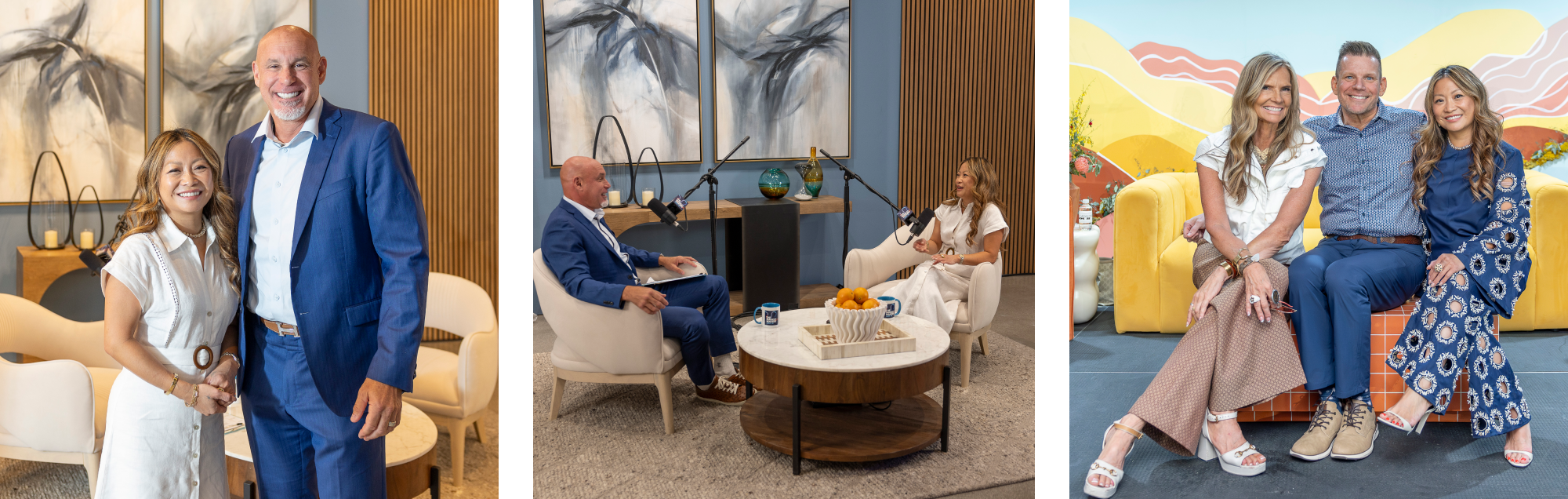
This week on The Market Makers, host Jon Pertchik sits down with designer Peti Lau, founder of Peti Lau Designs in Los Angeles, to discuss the importance of discovering your voice and trusting the path in front of you. She considers herself a “globe-trotting designer,” and for good reason. She uses her travels to fuel her work, bringing a layered, intentional and thoughtful approach to every project. Her belief that “no experience is ever wasted” isn’t just a philosophy; it’s the backbone of her design practice.
Born in Israel to Chinese-Vietnamese parents and raised in Washington, D.C., Lau first expressed herself in early childhood and adolescence through music as an opera singer and pianist. After her father’s passing at 17, Lau spent ten years traveling the world, including seven years living as an expat in Thailand. During that time, her travels were less about escape and more about discovery, and eventually interior design.
Today, Lau describes herself not just as a designer, but as a director. "I always love to say, I'm like the director and my clients are the writers and the producers. And together we're making a film, and I help them direct the film of how it's going to go. But really it's up to them how they want to write that story. I create a stage for them to live out their lives." This perspective and collaborative spirit are what fuels her work. Throughout the episode, Lau discusses her aesthetic, thoughtfully sourced products and why craftsmanship matters. She also reflects on receiving the 2023 Rising Star Award from her alma mater, giving her the validation that she didn’t have to “put on a costume” to be recognized for her work. She simply had to be herself.
Now, she’s dreaming about what comes next, whether it’s a product line or meaningful brand collaborations. Thoughtful, expressive, and driven by curiosity, Peti Lau’s story is a reminder that creativity often begins with wandering and that we should seize every experience, even the unexpected ones.
Peti Lau:
No experience is ever wasted. I think that's really what took me to get me to here. Every experience is benefiting to the person that you're going to become. You don't have to wake up at 18 years old and realize I'm going to be this.
Jon Pertchik:
Today on The Market Makers, how Peti Lau found her true calling through a decade of travel and exploration. Peti is a natural explorer and she finds inspiration in far away places, in her garden behind her studio. Her story isn't about following a traditional path. When I think of Peti, one of the thoughts that goes through my head is all who wander are not lost. It's about staying open to discovery. She believes no experience is ever wasted and that sometimes finding your voice means giving yourself permission to get lost first. Peti Lau of Peti Lau Design from Hollywood, California, maybe not from there, but that's where your business is in La Cienega is our guest today on The Market Makers. Thank you so much for being here. I'm really, really excited.
Peti Lau:
Well, thank you so much for having me. I'm really, really, truly excited to be here.
Jon Pertchik:
You were starting to tell me offline your name, how to remember, it's Peti, because it's spelled differently than maybe how you might think it sounds. So let's start there. I'm just curious what this story is.
Peti Lau:
So my parents named me Petit because I was born premature, so that's why it's spelled P-E-T-I. Well, and then they misspelled it. But then the way to pronounce my name is Peti. And I tell a funny joke. So there was a kid named Richard To, true story. And everyone would come up to me every school year and they say, "Hey, if you married this kid named Richard To, your name would be Peti To." And I love tater tots.
Jon Pertchik:
Well, you know what? I will never forget that.
Peti Lau:
Peti.
Jon Pertchik:
Peti To.
Peti Lau:
Or petit Peti.
Jon Pertchik:
And petit, but they did leave the T off, I guess.
Peti Lau:
Yeah.
Jon Pertchik:
Well, thanks for being here. There's so many places to start. You've been described as a globe-trotting designer. You have this cool background. It sounds like travel has really influenced who you are and your design work. Maybe share just a little bit about maybe the interest in travel. Where did that come from?
Peti Lau:
Growing up, I had a big map in my bedroom, and I think that really was subconsciously what inspired me to see the world. I was born in Israel. My parents were Chinese-Vietnamese. And then I moved to Washington DC area and I grew up there. And then I moved to San Francisco when I was an adult, young adult. I decided, "You know what? I need to get out of San Francisco." And I had an opportunity to go to Thailand. And so I ended up living in Thailand and that really kind of opened the world to Southeast Asia and then also Europe. I lived there for seven years as an expat.
Jon Pertchik:
Started in Israel. Can you share a little bit about how young were you when your family moved around those years?
Peti Lau:
I was there until I was four.
Jon Pertchik:
Wow.
Peti Lau:
And then my mom's family was living in Washington DC area. And then my dad's side of the family is in Los Angeles. Being able to move around with both sides of the family was kind of really what sparked the sense of openness and wanting to see the world.
Jon Pertchik:
Staying with first those earlier years, was your mom or your dad or others sort of a main influence on you, your mom or your dad, or who kind of helped form who you became?
Peti Lau:
I think what they inspired in me was probably entrepreneurialism because obviously they immigrated to America, they had typical Asian families where they had Chinese restaurants. And so I think that was something that was instilled in me to always kind of be an entrepreneur and try different businesses as my parents did. That was something always very innate in me. And so I love looking, finding different artisans and crafts. And it's one of my favorite reasons actually why I love to come to Vegas Market because of the small makers. But the design thing really kind of fell into my lap, to be honest. I was always creative. I was actually an opera singer. I was a musician. I played piano when I was seven and I just was like every Asian kid plays classical music. So I played the piano and then I started singing and I really found my voice.
But then when my dad passed away when I was 17, I didn't really want to be so much of a performer because I became kind of more recluse at that experience. And then that's when I kind of shifted. And I think that's where I spent the 10 years of my life traveling around the world trying to figure out who I was. And then that's how design kind of found me. So it's interesting because I think I was always a creative person, but I didn't really know where, how I got to it. But it was really this feeling when I was a teenager and I felt like I had this gift of being to have a voice to sing. And then when I couldn't sing or express myself, I was really quite lost. And I think traveling around the world was kind of my answer to find myself.
Jon Pertchik:
Wow, that's super interesting. I mean, so with the benefit of being mature and reflection, those early years of expressing yourself creatively through piano and singing, when you look back, I mean, that was this creative core of you coming out and expressing yourself.
Peti Lau:
Yeah, 100%. And I think that was challenging because most Asian parents want you to be a doctor or they want you to be a lawyer or a dentist or an accountant, which none of those things that I was. And so when I finally found kind of interior design, my mom really encouraged me to really go to school and get educated on it because that was for her. Her story was like, "You need to be educated and you need to have something and be something." And for me, my personal purpose was like I wanted to have a very strong foundation in knowing what I was talking about. I didn't want to be like an imposter syndrome.
Jon Pertchik:
A lifetime of wandering taught Peti something most designers never learn, how to really listen, not just to clients, but hearing spaces, hearing cultures, understanding people. And in a way that extra sense, ultimately as she got older and had more experience, that was able to manifest and she was able to recognize that. It taught her that every place has its own rhythm and her job is to translate that rhythm. Knowing that you went through this period where you started out very creative, you had, I guess, family saying at different points a traditional path, whether partly through education. I mean, any advice for somebody like that?
Peti Lau:
Absolutely. And I think it's the left brain, right brain. We're all trying to find ways to express ourselves. And I think people get frustrated when we don't have the ability or don't have the space to express ourselves.
Jon Pertchik:
And for the audience who may be a younger person figuring out life and where they're heading, staying, really what you're saying, I think to state it slightly differently but the same, is being authentic to who you are.
Peti Lau:
Yes.
Jon Pertchik:
And if you're feeling these, I don't know what you'd call them, pressures, desires to express yourself a certain way, you've got to let those out.
Peti Lau:
Keep going.
Jon Pertchik:
Don't stifle them.
Peti Lau:
I mentor a lot of students, design students, and just to anybody in general, I always say no experience is ever wasted. I've done everything under the sun. And I think that's really what took me to get me to here. And also being an interior designer, it's a multifaceted skillset. You have to be able to do so many different things all at once. And so every experience that you do is really part of kind of benefiting to the person that you're going to become. And you don't have to wake up at 18 years old and realize like, "I'm going to be this." And I think that's really my personal lesson. I thought I wanted to be this opera singer and then life happened and then I'm like, "Wait, no," and then I was lost. And then part of it is just the discovery of trying different things.
Jon Pertchik:
Maybe speak to what is your process? You've already implied how the research you were doing in the beginning for the red Chinese bordello as you described it. What is your process? So you sit down with a new client and what happens?
Peti Lau:
I feel like being a designer, obviously people always say you're a therapist and it's only like 10% creative, but the rest is just logistics, which is totally true. But I think it's really being very intuitive. I think if you're a creative person, you're really like tapping into the person that you're designing or the family that you're designing the space for. Besides a series of questions that you ask, I think it's just really kind of feeling them out. And so I always love to say I'm like the director and my clients are the writers and the producers and we're making a film. And I help them direct the film of how it's going to go and the movement and the style of it, but really it's up to them of how they want to write that story. And so I create a stage for them to live out their lives.
Going back to the whole why I kind of bring... There was another moment when pinpoint for me when I was like, "Okay, this is it. I want to be a designer." When I was in high school, I was in theater, music and theater, and I got to direct a one-act play. Usually I was always on stage, but this was the first time I was behind the scenes. And being a director, all of a sudden, this moment when the actors were on the stage and I could see the visual coming to life from my mind. And the same experience happened when I first installed that red Chinese bordello house. That was that light bulb moment. And to this day, I think every designer, when you get to that end point, when you get to install and you're shooting photos and you get to see the photos, that's like the crack that I live for.
Jon Pertchik:
Right, right. Because I mean, that's when it's real. You go from-
Peti Lau:
That's when it comes together.
Jon Pertchik:
Being a good listener, being intuitive, those are internal concepts, what happens inside your head that's unique, and listening to the writers, your customer, your client, to then go through this process of creation, which is still coming just completely out of your special brain, to then express it and then to finally see it, that's got to be pretty amazing.
Peti Lau:
Yeah. That's the best part. And then obviously the icing on the cake is really just having my clients or the people that I work with when they're just super happy and I see them posting things in the space and they're just living their lives. And that really to me is what makes me keep going.
Jon Pertchik:
And I love like when I think about great design and great designers, I think of like the word home, not as a noun, but as a verb. You are giving people the ability to home. They get to define with your creativity, how they create this safe, special place, whether they're raising kids or with their significant other. I mean, you get to do that. That's a pretty cool thing.
Peti Lau:
That was a full body yes. I've got goosebumps all over.
Jon Pertchik:
Wow. All right, cool. So we're successful so far today. We're here sitting in the Vegas World Market Center. Maybe the process of discovery. So as you're going through that creative process, what is that like, that discovery process of finding the things? Now that you've got the design probably in your mind sort of laid out, you're starting to pencil out things, I imagine, what is that like for you?
Peti Lau:
Well, the best part is when you're not expecting what you're going to find and then all of a sudden you see something and you're like, "Oh my God, that's so freaking cool." So I think that's something that's really important because that's kind of like when you think back like old school days when designers would go travel because they didn't have the internet and they would find these amazing things and that was like such a big thing. And nowadays, everything is a visual aesthetic online, it's a two-dimensional or one-dimensional. So really it's for me, I feel still very old school about that. Part of the discovery of finding something I didn't expect, that's like the gold nugget.
Jon Pertchik:
That's what we were talking about too before we started, like the texture of boucle or the smell of leather, you just can't get that unless you're there and you turn the corner and there's something you see.
Peti Lau:
Absolutely.
Jon Pertchik:
The part about tradition and breaking the rules, I want to touch on the breaking the rules part. You were granted or awarded, honored with a 2023 Rising Star Award, which has got to feel amazingly special having gone to that school. Right?
Peti Lau:
Yeah.
Jon Pertchik:
So I watched your speech. And in your speech, you talk about how you worked in the admissions office.
Peti Lau:
Yeah.
Jon Pertchik:
Maybe share that story with folks because talk about breaking rules. I love this. This is so cool. So it's not just some little fun story, but it actually ties to how you express yourself. So maybe share that story.
Peti Lau:
So when I did those projects, the ones at the red Chinese bordello, I photographed it and that was kind of my submission. And so when I was going through, I found my file and I remember and I looked at it and I had those photos.
Jon Pertchik:
So you're in admissions and you found your file.
Peti Lau:
I did.
Jon Pertchik:
Okay. I want to just make sure we're kind of like exclamation for it. I love this.
Peti Lau:
I was working in the office and the admissions office and then somehow I found my file and then I basically kind of like snuck it and looked at it. It was good because obviously it was like a couple years in into the program and deeply involved and I kind of... It was not only like an amazing moment to see where I had started, but then to see David Sprawl's notes like, "Had potential."
Jon Pertchik:
I think you were promising or promising potential.
Peti Lau:
Yeah, it was promising. And that was super touching. And I was so nervous at that talk, I mean, getting up there and talking. I don't feel like I'm the best public speaker, but-
Jon Pertchik:
You did a great job.
Peti Lau:
Thank you.
Jon Pertchik:
I thought it was really heartfelt and you were very much of an authentic person. That's obvious in a little time I've got to know you and doing some research. And that really came through.
Peti Lau:
Thank you so much. I remember I looked out and I saw David Rockwell looking up at me and I was just like, all these incredible people that I admired. And then the next day I was, actually a funny thing, I had a doctor's appointment and I was wearing nothing, just like baseball hat. And I ended up, I was like, "You know what? I'm just going to go and pop into Todd Merrill," because that's across the street from my doctor's office. And I walked in and he recognized me. And Todd Merrill is a huge antique dealer and he recognized me and I was kind of, typically I would've been embarrassed to be walking the way I was, but I didn't care. It was the first time I felt like I was being validated. And he congratulated me and I was like, and that was such a beautiful moment that I had of like, oh my goodness, I don't need to put a costume on. I could just be myself and just to have that incredible moment to be-
Jon Pertchik:
Just be comfortable in your skin.
Peti Lau:
Yeah, to be honored in that way was just-
Jon Pertchik:
Again, I appreciate your openness with me and with our audience about, I mean, talking about that moment-
Peti Lau:
Of course. Only way to be.
Jon Pertchik:
... the first moment of empowerment when you have that first project and this big moment of validation. That's pretty awesome.
Peti Lau:
I will never forget that opportunity that I was given because it really truly changed the course of my life and empowered me that I could do it.
Jon Pertchik:
A lot of people think luck is this random thing, the wind blows your way or it doesn't, and it doesn't work like that. I think we have more control than we realize. Luck is really having the advance preparation to grab an opportunity, seeing something, recognizing it, and then doing something about it. Every single day random things happen that could have been converted into something great had you had the self-awareness to see it, understand it, and grab it. But even success raises new questions. After years of building, of proving yourself, what comes next?
Peti Lau:
I've kind of been at this point right now where very, very honestly, I'm at this kind of juncture like, "Okay, what's my next chapter going to look like?" And I think one of the things I've been very fortunate is to be around some really incredible other fellow designers and I have a really great community of people. And is it like doing a product line, a brand? And I've really learned that it's really important to partner up with the right companies because it's like a marriage, and really making sure that it's a right fit. So yeah, so I'm really interested in moving into finding brands that I really want to work with and kind of mixing between the two. Because I think the work that I've been doing has been a lot more elevated and it's unique to kind of a different aesthetic than what most people are used to, I guess.
So I would really love to do a boutique hotel. Anybody out there looking for a designer? Because that's kind of where I came from, living and working in a hotel, I love that hospitality aspect. And I think even now more days with Instagram and everyone's traveling, we have so many of these big groups, but what makes your experience and your stay unique? It's about these little tiny nuances. And I think also with my designs, I really focus on the nuances of like beautiful craftsmanship and working with interesting vendors. So yeah, I definitely want to continue that and working with, finding like beautiful crafts around the world.
Jon Pertchik:
I love this idea of this craftsmanship, that word, because it's unfortunately in this day, modern day of technology and even AI and otherwise, handmade things, whether beautiful watches, even cigars, the word craftsmanship implies a real high touch, real attention to detail, and a lot of that is just getting lost and technology seems to have a place in that. I mean, technology is a great thing, don't get me wrong, in our business and in our lives. It's really important and it creates a different kind of quality of life for all of us. But I almost feel like the pendulum will swing back a little bit. I think human beings are drawn to the aesthetic, and aesthetic and design is really about emotion, and emotion can't be fulfilled by technology.
Peti Lau:
That's such a conversation, another hot topic of AI and will AI replace designers. That will never happen because AI is basically, it's a tool. It's taking information out there and putting it all together. But I think using what you're kind of imagining, that's coming from your soul. Every person, every fingerprint is different. You're going to put it in your own story. But I think that the texture of the craftsmanship, that's what takes it to the level of the luxury. I think people will focus more on craftsmanship, and it has become that way. And I think what's been really nice to see at Market on this trip that I've been seeing is a lot more of the brands have really focused on better quality techniques and upholstery and finishes. That's really exciting to see.
Jon Pertchik:
There's like this beauty and imperfection too, where there's a stitch that's not perfect-
Peti Lau:
But that's done well.
Jon Pertchik:
Right, but it's high quality. But I think people are drawn to that a little bit because there's like a soulfulness. There's something deeper that-
Peti Lau:
Thoughtfulness.
Jon Pertchik:
... AI just can't really replace.
Peti Lau:
Yeah, exactly. It's thoughtfulness, I think. I think we appreciate when someone takes the time to be really thoughtful with what they're doing. And at the end of the day, that's what design is. Design is just being thoughtful and really considerate of the things that we're putting out into the world.
Jon Pertchik:
Well, I so enjoyed our time together. This is amazing. So we're going to see possibly some product design, hopefully a boutique hotel, heavy on the craftsmanship kind of priority in the future with Peti Lau. And thank you so much for being here today.
Peti Lau:
Thank you. Thank you so much for having me.
Jon Pertchik:
I really enjoyed this.
Peti Lau:
Me too. It's been wonderful.
Jon Pertchik:
Thanks.
Peti Lau:
Thank you for having me.
Jon Pertchik:
There's something Peti said that stuck with me. Design is just being thoughtful and considerate of the things we're putting out into the world. The human touch, the imperfect stitch, the thoughtful choice, the soul in the work, that's what matters. Peti's worldview is so profound, it's selfless, it's giving, and it ultimately says everything about who Peti is as a person. Peti's deciding what comes next. Product lines, a boutique hotel, whatever it is, I know it will carry what she's always brought, thoughtfulness, craft, and a story worth telling. I'm Jon Pertchik. If you enjoy today's conversation, follow along and join us each week for more stories of transformation from the people shaping how we live, work, and gather.
Want more conversations like this?
More amazing guests are on deck. Subscribe to stay in the loop.