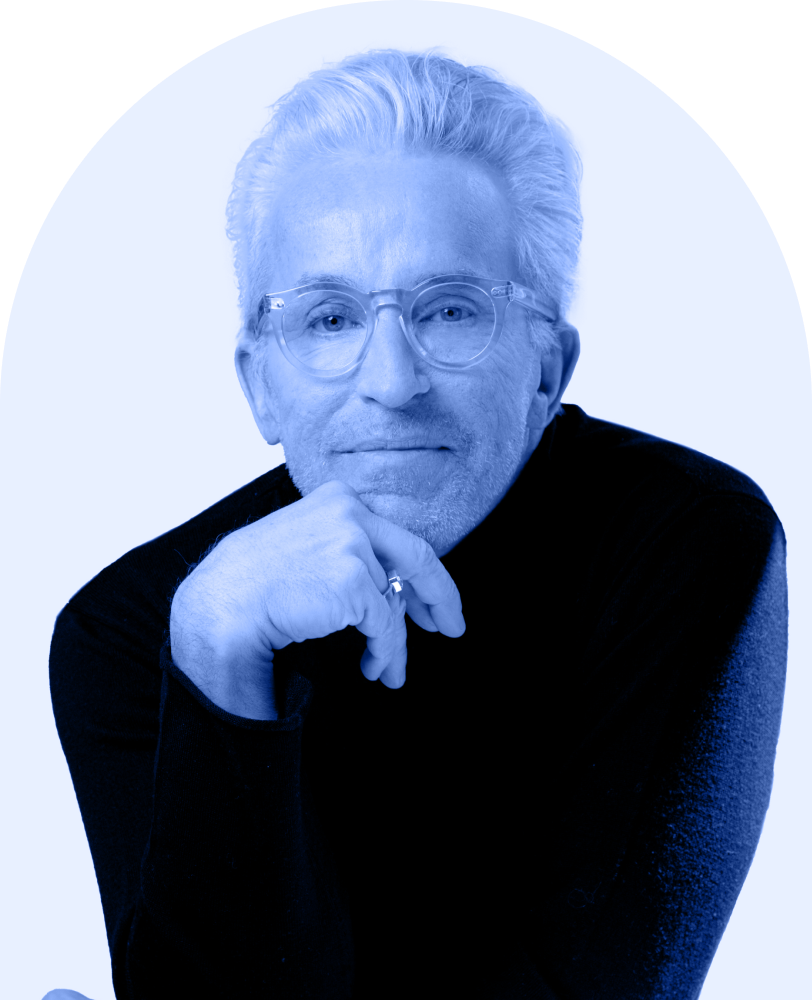
EPISODE #110
ROGER THOMAS
A Lifetime of Design You’ve Never Seen Before




“I started facing my fears and learning that you can survive your own authenticity. You just have to try.”
Those are not the words you would have expected to hear from one of the most legendary designers of our time. As Roger Thomas shares his revolutionary approach to creating transformative spaces today on The Market Makers, we hear him describe how he came to pioneer his trademark Evoca-tecture – “evocative architecture.”
The authenticity Thomas speaks of surviving is rooted in the same authentic human emotion that drove this unique approach to his incomparable designs. “How are you going to make the guest feel their best selves? By creating spaces of possibility.”
On behalf of all of us who admire and aspire to those heights, ANDMORE CEO Jon Pertchik asks Thomas about this revolutionary and deeply philosophical approach to design: “How do you pull it off?” Thomas’ thoughtful reply: “I think you could put it down to connoisseurship. I learned…all the materialities. I was really investigating them, dissecting them. I realized [my] job was to make [my] own dreams come true and was willing to go to any length to do it.”
Thomas’ business circumstances are as singular as his mode of design. Undeniably a unicorn in both arenas, he spent over 40 years partnering with the same clients – Steve and Elaine Wynn. Modern Las Vegas was shaped by this trio, with Thomas at the design helm. Going forward, beyond the latitude and altitude of the famed strip, these three luminaries then became the conjoined power behind some of the world’s most extraordinary resort destinations.
Over and over again, the Wynns gave Thomas an impossible challenge: design something no one had ever seen before. Thomas explains how he went about solving the repeated puzzle. “I had come to understand that just selecting the most beautiful materials and combining them in a fetching way was not my job. My job was to create drama and joy and comfort, entertainment and romance and surprise.”
Evoca-tecture.
Thomas and his team invented entirely new vocabularies of design. That kind of creative risk-taking doesn’t happen by accident. It requires both exceptional talent and the courage to trust your instincts.
The result is a lifetime of lessons that he not only continues to build upon, but also graciously and expansively shares. It’s why Thomas is spearheading the effort to fund and establish the Las Vegas Museum of Art. And it’s why he finally agreed to author a book.
Thinking of his own daughter’s art education, Thomas says, “I thought about [her] and how important I considered her education.” Then he went on to recall his own education, musing over his immersion in and fascination with the history of 100, 200, 300 years ago. “Las Vegas is a transient place…everything gets replaced. All of this work should be recorded…to give a little sense of place for those who might come a hundred years hence and wonder how the hell did that happen?”
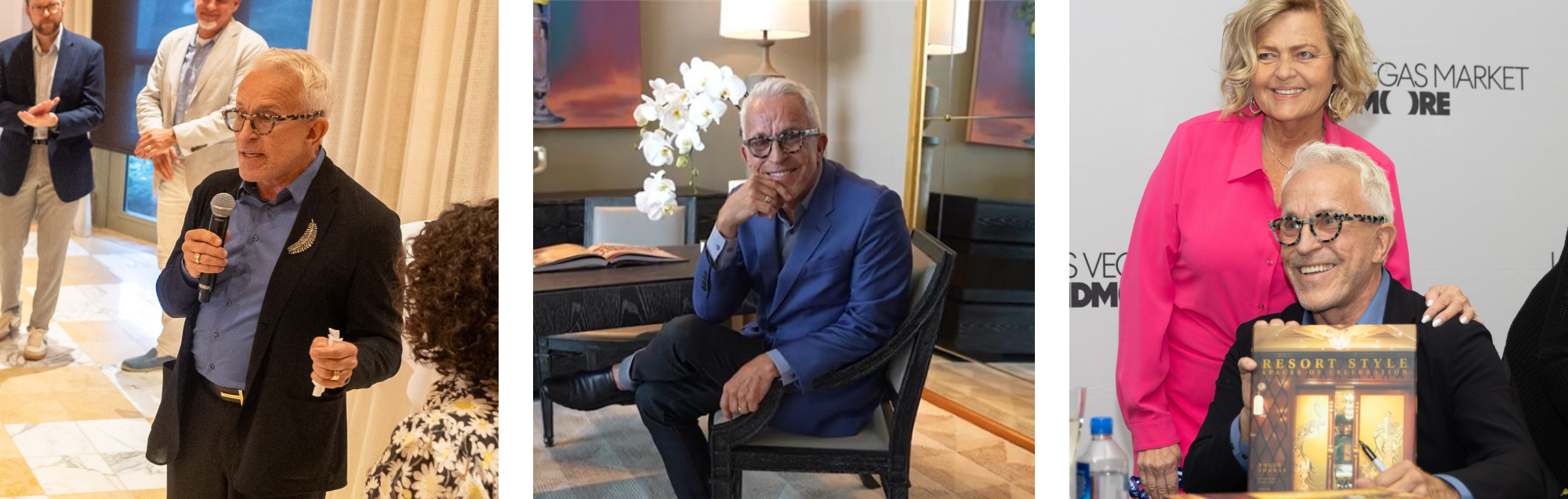
That record, written during the pandemic and called Resort Style: Spaces of Celebration, is a compendium of the beguiling configurations and emotional artistry that make up Thomas’ oeuvre. It’s not only an illustrative chronicle of his grand and outrageous insight and inspiration, but also the teaching tool he envisioned—another way to challenge your creative self every day…from your coffee table, your bookshelf, your nightstand.
Learn more about Roger's collected body of work by visiting The Roger Thomas Collection.
Roger Thomas:
I realized that if I was going to create things that no one had ever seen before, I was going to have to take greater risks, that I was going to have to put my authentic self, my dreams that no one had ever seen out there. And some of them might be great and some of them might be awful, and I was going to have to accept both results. I started facing my fears and learning that you can survive your own authenticity. You just have to try.
Jon:
Today on The Market Makers, legendary designer, Roger Thomas, shares his revolutionary approach to creating spaces that transform how guests experience luxury. Roger is an absolute legend in the design community. From the Bellagio to Wynn Las Vegas, Roger has spent over 40 years partnering with Steve and Elaine Wynn to design some of the world's most extraordinary resort destinations. Roger coined the phrase Evoca-tecture, meaning evocative architecture. He actually walks into an empty space and he imagines, effectively closes his eyes and imagines what moments should take place in that space based on where it is in a given casino, in a given resort, in a given building. What are the kinds of moments that will take place in there? He then works backwards to start to decide what kinds of emotions should that space create or evoke.
Roger Thomas:
When you're asked to do something that no one has ever seen before, you realize you have to invent absolutely everything in the space. You can't have seen the chandeliers, the carpet, the chairs, the wall covering, nothing can have been seen before.
Jon:
One of my favorite aspects about Roger is as much as he's a visionary who sees into the future and can envision combinations of colors and textures, he also is very old school. He's been at this 40 years, and in all of that time, he carries around his famous notebook. He literally has every notebook that has all of his notes, his observations that are usually spontaneously generated when he's walking through an art gallery, walking by a building, seeing something that catches his eye and he makes a note, he makes a sketch, he creates shapes, he creates forms, he puts color combinations together. He always has it with him. So he can literally go back and reflect to see, "Oh, there was this shape that I'd like to go back to," or, "Oh, I'm working on this project now and geez, I remember five years ago there was this thing I saw," and he goes back to that library of notebooks and uses that to then apply going forward.
It's really remarkable and it's really old school and I love it. Thanks for listening and I hope you enjoy my conversation with Roger Thomas." Roger was repeatedly given an impossible challenge, designed something no one has ever seen before, not just new, but completely unprecedented, and he's done it over and over and over again over 40 years. Roger Thomas is a genius. What you're about to hear is how he thinks, how Roger approaches the impossible and why his work has changed the definition of what luxury means in America.
I am honored. You are a legend, Roger, an absolute icon, and I'm really honored to have you. So first of all, welcome, Roger, and thank you for being here today.
Roger Thomas:
Thank you, Jon. It's a pleasure to be with you again.
Jon:
Again. We had a chance to meet briefly about a year ago, very briefly. More of a handshake and I had the honor to actually introduce you when you were granted a Lifetime Achievement Award at the Wynn Resorts.
And there's so much to talk about and so I'm really excited to get going. Resort Style Spaces of Celebration is your book. Cindy Allen, Interior Design Magazine editor-in-chief has some amazing quotes about you. And when I close my eyes and I imagine some of the spaces I'm familiar with at Wynn, which is where I stay there at Encore when I'm in Las Vegas, which I'm there a lot, what she describes, I think captures some of it. She's called both Encore and Wynn, Wonderlands of Extraordinary Going for Broke Opulence. What does that mean? I mean, I have a picture, an image. How do you go about creating these amazing spaces?
Roger Thomas:
Well, I go about creating amazing spaces by starting with an extraordinary partners. Steve and Elaine Wynn were amazing in terms of clients, I think completely unique. And they were my only clients for the last 40 years of a 55-year career because if you have Steve and Elaine Wynn, why would you look elsewhere? You're at the top of the game. And Steve's request when we sold Mirage Resorts, which had Bellagio, Mirage, Treasure Island, Gold Nugget, all those other creations we had worked on, which I now look back and see as learning experiences, asked when we started designing Wynn Las Vegas for number one, the most exceptional and extraordinary luxury hotel on planet earth, to which I said, "You asked me for that the last time. And had I known you were going to ask again, I wouldn't have tried so hard with Bellagio." And two, he said, "This time I want something that no one has ever seen before." Because he had assigned preexisting vocabularies for my other projects.
With Bellagio, he was enamored of the south of France and I was spending a lot of time in the north of Italy. Of course, with the Mirage, we were in a tropical mood and Treasure Island, which was something we both regretted after we finished it, we were Imagineering in the technique of Disney and reading an awful lot of Robert Louis Stevenson and watching every single pirate movie we could find. So those had inspired vocabularies, but when you're asked to do something that no one has ever seen before, you realize you have to invent absolutely everything in the space. You can't have seen the chandeliers, the carpet, the chairs, the wall covering, nothing can have been seen before.
Jon:
I had seen an interview that you and he did together a few years back. And when I hear you describe what your charge was for Wynn, I reflect on his description of the Fontainebleau in 1954. And at that time, that was almost what you described. So tell me a little bit about his view of the Fontainebleau and how that maybe indirectly or directly inspired almost that next generation of iconic top of the absolute mountain design and resort.
Roger Thomas:
So The Fontainebleau was designed by Morris Lapidus, who was an absolute genius. He had reinvented the way retail was experienced in New York City and other places, and the way retail even as a result was marketed. And with the Fontainebleau, and I know this because I was recently interviewed about Morris Lapidus, and Steve had talked a lot about them. Steve and Elaine Wynn, by the way, met at the Fontainebleau. And so it's very important to our culture and our understanding. Morris Lapidus did something that I intentionally did, and that was to design cinematically. That was to present these extraordinary stage sets on which all of the guests could perform the best moments of their lives. And I had come to that through a different understanding, probably equally painful to Morris's discovery, but I think that's what The Fontainebleau did for resort design.
It was not just a hotel you would visit, and it had great service and expensive marble and beautiful other things, whatever. It was intentionally set up as scene after scene after scene, as if you were going to live the movie that's the best movie of your life. And that was something that I came to also by the time I designed Wynn, I had come to understand that just selecting the most beautiful materials and combining them in a fetching way was not my job. My job was to create drama and joy and comfort and entertainment and romance and surprise. Those were the elements that I had to accomplish. So when we sat down for design meetings, my extraordinary talented group and I, and when we were designing Wynn, we started at 11 and had 120 people by the time we finished, I would go into a meeting for a space, let's say it's the casino and say, "Okay, how are we going to establish drama?" And in the case of the casino, it was, we're going to use high contrast in color.
I'd never seen a brown and white casino. Let's start with that. "What do we do for romance?" And I had come to understand that the romance was immediately evoked by the forms of the female curves. So we used female curves and decided that maybe one of the most romantic shapes ever was the parentheses. If you look carefully, you'll find lots of parentheses at Wynn. And what do we do for surprise? Joy was easy because all we had to do was look at one of Steve's Matisse paintings in his collection and immediate joy comes just because of the masterful palette of Henri Matisse.
Jon:
Did you and your team create that sort of perspective or that, I'll call it a paradigm, that approach, because when I hear you say that, it seems so intuitive. Of course, that's how design great design should be, but the bigger part of me goes like, wow, you're getting into sort of human psychology and human emotion and getting to sort of the root of emotion of what conjures these positive feelings. So it makes sense, but I've never heard anybody describe that. I mean, tell me more about where that recognition and ultimately that approach, what was the genesis of it?
Roger Thomas:
Well, I think we were the first, and I even gave it a title. I gave it a name, which is called Evoca-tecture. And it was a combination of two things, I think. One was Steve's consistent, and Elaine's consistent encouragement to, during every moment of design concept, to think like a guest. How are you going to make the guest feel these various feelings? How are you going to make the guest feel their best selves? And another thing that I always like to say is that we are creating spaces of possibility. This is a place where you're going to remember to say wonderful things to people. This is a place where you're going to maybe remember to pop the question. And the other one was Las Vegas at the time, just before that, was going through a real period of what I've also coined a phrase for, which is replicature, which is trying to make someone believe they're in another place and/or time in a Las Vegas Hotel Casino.
We had tried it with Treasure Island and agreed mutually, Steve, Elaine and I and my entire team, that we failed miserably. You can't do it. It's an impossible task. Don't ever try that again. Bad designer. Put down that thought and never go there again. But that whole thing of thinking like a guest and not replicating anything and Steve's demand that we create something no one had ever seen before, well, I couldn't go to just picking chandeliers and chairs and things. Out of the question, they've been seen before. They're in the marketplace. So I had to think of an avenue, a way for us to focus our decisions that did not rely on the way we'd always thought of designing things before. And I realized that we had been doing this for years, and particularly at Bellagio. We wanted to change the guest experience in Las Vegas, make them feel more dramatic, more romantic, more comfortable, more joyous, more intrigued.
Mystery was a big part of it. So I formalized the thought and that became the conversation focus.
Jon:
It's amazing. I mean, you're right. I hadn't thought of this either, but so much of Vegas is a facsimile of something else or an attempt to be another thing, replicature. Good design, to me, it's really about emotion and feeling, but to then take that and create a paradigm around that and approach to design around that, I think that's a much deeper experience and more meaningful. And tell me a little bit about Bellagio and the evolution of your history and your design. I know going back before when Bellagio seemed very significant too. I remember when it opened '98 or something, late '90s and going there in the first few weeks, and it was such a big opening, such a big deal. It seems so different than what anything else Vegas had at the time.
Roger Thomas:
It was bigger. It was different. It was truly the first 100% luxury experience, but it was also a complete change in the economic paradigm of a Las Vegas Casino Resort hotel. So Bellagio was designed to improve that economic model. So for restaurants, he invited Sirio Maccioni at Le Cirque to have a restaurant. For retail for the first time really in Las Vegas within the hotel, we had Miuccia Prada and Giorgio Armani and Chanel. We had really elevated retail partners. And before that, we had owned a lot of the retail, but we did not have the appeal of an instantly recognized brand like that. We did not have world-class chefs whose names were recognizable and the design had to elevate itself to that same kind of experience. We had a big problem that we recognized by then. The Mirage was the first 2,500 room resort,
the first mega resort.
So the casino had to be big enough to hold those people. Steve kept saying, "The casino's too big." So my suggestion was a simple one and one that had never been done before. Why don't we put the casino cage in the middle of the casino and that way we get two casino for the same square footage and you don't have the vistas that you would have otherwise. I also had some other challenges because he wanted this complete feeling of luxury. One of the things we wanted to do was eliminate confusion in these huge properties. And if I had these crackpot ideas, he would let me pursue them if he agreed with them. And he almost always agreed because we were both focused on the same thing and that was guest experience. Guest experience is composed of so many subtle background moves. If the background isn't great, then the big stuff you put in front of their face is not going to be as good.
Jon:
Roger has an amazing ability to see and combine colors that are bold. They're courageous. Frankly, to Jon Perchick, who is very poor at combining colors, it's magical. But what strikes me most about Roger's philosophy is the depth beneath the surface. Yes, the spaces are stunning, the bold color combinations, the intricate details, the careful choreography of every view, but behind all of that visual brilliance is something more fundamental. Partnership, courage, and an unwavering commitment to creating something no one has seen before, often raw invention. Roger and his team guided by Steve and Elaine Wynns vision, didn't just select beautiful materials. They invented entirely new vocabularies of design, challenging themselves at every turn to combine colors, textures, and forms in ways that felt both daring and harmonious. That kind of creative risk-taking doesn't happen by accident. It requires both exceptional talent and the courage to trust your instincts.
When I picture an image in my mind of any aperture, any view with the Wynn, it's like a frame. There's so much detail that's been choreographed. Do you and your team have natural eyes for that? How do you combine colors so boldly and pull it off because it can really be cheesy if it's not done well, and you just pull it off better than anybody.
Roger Thomas:
I think you could put it down to connoisseurship. When we traveled, we always traveled focused on museum experiences. I don't know how many millions of works of art I have viewed in my lifetime, but it's close to a million. And I don't just look at art. I really, really spend time with it. I've spun around, see what most attracts me, and I spend 10, 15, 20 minutes, often I draw it. Jane and I were not trained as interior designers, but we were both trained as studio painters. We were both trained as weavers. I was also trained as a ceramist, a sculptor, and a metalsmith. So I learned all of these materialities, and that meant that when I looked at these materialities as created by masters, I was really investigating them. I was dissecting them. I was figuring out, "When Matisse painted that painting, what went down first? Why did he make a decision to put that particular coral next to that particular green? Which came first, the coral or the green," so that I could learn how color combinations happen.
We also had the advantage of having an extraordinary library that was built at great expense. So when I opened a color box of Ruhl color palettes, I wasn't opening a color box. I was opening maybe 10 different manufacturers, color boxes, some of them containing 50 different shades. And Jane and I would just spend hours fine-tuning our color selection. Then we would order a sample, and that would usually result in several more hours.
Jon:
Where does that come from, this natural curiosity that drives you to do the things you just described? Have you always been this naturally curious person who pays a lot of attention to detail?
Roger Thomas:
I've always wanted to know how it was made, always, since I was a little boy. My first experience at a museum was when my parents took me to San Francisco and to the Palace of the Legion of Honor. My mother had art books galore in the home because she was very interested in art. She was a talented artist herself, and I was the kid who sat in the corner looking at all of these art books and trying to figure them out. And then when I go to museums figuring them out, I went to a fine arts high school. I didn't go to a normal high school, thank God. And I've always, always, always had to do that. And I think in my profession, because both Jane and I realized that our job was to make our own dreams come true, we were willing to go to any length to do it.
Jon:
I hope you appreciate how extraordinary your perspective is, and I'm not saying that just to compliment you, there's this inherent aspirational reaching that's inside of you. And I've read this about effectively manifesting dreams. You can't bottle that. That's just somehow within you. I mean, tell me a little bit about that and where does some of this drive come from?
Roger Thomas:
I'm one of five children. I can remember closing my eyes and being able to build environments or whole worlds, move things around, recolor them. I thought everybody could do that until I was in my 30s and someone told me that they couldn't.
Jon:
I worked at one point with a designer named Kemper Hyers. He's the head of design, I think for Auberge now. And I remember walking into spaces with him and he would just immediately start firing. He would see things and it was like hallucinations to me. I couldn't see any of it. And it's so amazing to hear that. And so you were in your 30s when you realized this special superpower you had was unique?
Roger Thomas:
Steve had it too, and Elaine had it as well. So the people I was in these deepest conversations about were doing the same thing I was doing. And I think a lot of people in our industry have that superpower as well. So I was kind of surrounded by people with the power and not recognizing that not everybody else had it.
Jon:
Along those lines, when did this sketchbook become a part of you?
Roger Thomas:
I had, along with my superpower, came great learning disabilities. I was severely dyslexic. I had great trouble in school. I could not read as fast as everybody else, couldn't spell anything, probably still can't. So sketching was something that I did really well. When you fail over and over again at a task, you tend not to go back to that task. And when you succeed over and over again at a task, it becomes your favorite thing to do. And I successfully drew everything. So I think I've always done that. I have drawn everything that I've ever been inspired by and I've drawn every thought I've ever had. I may not need a doorknob in my particular assignment at the time, but if a doorknob comes to me, I draw it, or a chandelier or a chair or whatever. And so when I need to come up with things no one has ever seen before, that was really easy.
I went back to my last 20 years of sketchbooks and pulled out things I had never used before, invented, and no one had ever seen before.
Jon:
Interesting.
Roger Thomas:
So a lot of it was just the result of things I'd already imagined.
Jon:
And when you go back to historical sketchbooks, similar, I imagine like to the library that you described earlier, do you periodically just kind of peruse, browse through older sketchbooks or do you remember something somewhere or a little bit of both?
Roger Thomas:
Yeah, I did. I did that particularly with Wynn because this demand that I create something no one had ever seen before and I needed to produce rather quickly. One of the early discussions about Wynn Las Vegas was the original name of Wynn Las Vegas was Luev, Steve's extraordinary 1932 Picasso Masterwork, which interprets as the dream, and he was going to actually name Wynn Las Vegas La Reve. It was Steven Spielberg who said, "What, are you nuts? You've got the best brand name in the entire industry and you're ignoring it, you've got to use it." So our original charge was, "I want something that feels dreamlike." And because I was in the room with Steve with Claude Monet's portrait of his wife with a parasol, I had been drawing parasols, inventing different parasols. Steve would climb on a phone call with someone else. We would have a break in our conversation and I would draw my imaginary parasols.
So in the middle of Wynn is the parasols as a result of that. And my solution to the dream was what if we populated this area with immense parasols, they turn, they move up and down, the light on them comes up and goes down. And you're having a conversation with someone you particularly like and you look at the parasols, then you go back to the conversation. And when you look at the parasols again, they're not the same. They've changed. My dreams have stop action. And so I thought that was a good interpretation of the dream.
Jon:
Sometimes the greatest creative breakthroughs come not from technique or talent alone, but from finally allowing yourself to be fully, unapologetically who you are.
Everything you're describing, it's obvious it's so cool to like who you are, not some facsimile of who you are. So maybe speak to authenticity and how that manifests in your work.
Roger Thomas:
Well, my book, Resort Style Spaces of Celebration is about my last 20 years and starts with Wynn Las Vegas because I think the combination of my life changes and Steve's demand that I create things that had never been seen before combined into true authenticity. Before that, I had vocabularies that I could riff on, but I was still asking myself questions like, "Oh God, I really loved that room at X place. What was the magic of that room? How can I recreate that magic in my new room?" And I didn't do that at Wynn. I had just at the beginning of Bellagio, I had a major life change. I told my wife of 14 years that I discovered that I was actually a gay man, which was something that was difficult to explain to a seven-year-old daughter that we had at the time. So that was a change in real personal authenticity and exploring my authenticity as who I really was.
Jon:
Do you mind if I pause on that? And just, boy, that speaks to a lot of people's reality in life. And how did you get the courage to do that and let your true self be your true self?
Roger Thomas:
Well, I was brought up in a world where being a gay man was not easy enough for me evidently. And certainly in the religious and familial background I had, I got all the signals that it was going to be difficult and that I might even be pitied and I didn't want to be pitied. I was aided in the disguise by ... My wife was someone I truly loved. I truly fell in love with her, had a very romantic relationship with her. We had a wonderful life together. So that was a big help. But as we moved through those early romantic, passionate years into the nuts and bolts of creating a life with a child and doing all of those things, it was less about that kind of romantic passion. So I was no longer distracted by that and I was
beginning to be distracted by other things.
I noticed that when a couple walked in the room, I didn't look at the woman. I looked at the guy. There were 4,628 major clues in my lifetime. When I told Jane Radoff, my design partner's husband that I was gay, he said, "You didn't know?" It was one of those things that was obvious to other people and not obvious to me. And there were some other life changes that happened at the same time. I had been drinking way too much and completely stopped drinking through a wonderful change of life that I've managed to maintain. So all of those things combined to make me more authentic. And with that, I realized that if I was going to create things that no one had ever seen before, I was going to have to take greater risks. That I was going to have to put my authentic self, my dreams that no one had ever seen out there.
And some of them might be great and some of them might be awful and I was going to have to accept both results. And I realized that that was my job. That was exactly what I was supposed to do. If I wasn't moving the marker to the edge, just about to fall over the cliff, why bother? That it was that frisson of maximizing all of my intentions that everything was about. And that's what I was supposed to be doing.
Jon:
So are you saying, I mean, facing your true self and allowing that to manifest gave you almost the courage, the backdrop, being that authentic self to take greater risks like what you just described? Is that relationship there?
Roger Thomas:
I survived the greatest fear of my life. I came out that my parents were supporting me, my family was supporting me, even my ex-wife learned to support me. And so I realized that what are you afraid of? Why not go for it? It's all survivable.
Jon:
So often people fear things. I said to my kids, "People will fear things." It's a human condition to flee or fight one or the other, but it's this automatic reaction and that's filled with fear. And what we all I think have to do is to break that down and understand it, break it into its parts and pieces. And most fears then become relatively manageable if you do that. But having had faced the toughest situation, the toughest fear and overcoming it, I guess it was probably liberating and gave you the ability now to not be so fearful and take some of these risks.
Roger Thomas:
Well, and as my success was growing, I was getting more and more afraid of the people that I was being successful around. They had greater reputations, they were more important. And my reaction to that when I went to a cocktail party or a dinner with them was to have cocktails to smooth it out before. And by the time I got to the event with these scary people, I was fully fueled. And I found out when I stopped fueling myself in anticipation of that, that not only was it survivable, it was completely more enjoyable and that bringing my real self to the party was what I should have been doing the whole time, but it was my greatest fear. Showing my real self at the party, I was going to be judged not enough. I was going to be whatever. It was this, I was afraid of everything and bringing my authentic self allowed me to relax and enjoy them as much as me.
I was afraid of what the conversation was going to be like. And I learned that if I was with this person that I was afraid of and I said, "I want you to tell me about whatever." I would ask a question. They were perfectly happy to talk about themselves and I didn't have to fill in anything and I learned something at the same time. So I started just facing my fears and learning that you can survive your own authenticity. You just have to try.
Jon:
So the book, Resort Style Spaces of Celebration, I guess this reflects these last 20 years or so, plus or minus that this sort of newer period for you, speak a little bit more about the book and what is it giving to the world?
Roger Thomas:
Well, the book happened as a result of my husband, Arthur's inspiration. And Steve would often say, "That hotel is so great. We've got to do a book about it. I want you to do a book on it," and I would start organizing my thoughts about that, getting the photographs together. And he'd have another big idea for another resort that completely took all of my attention and the book went to the side. I retired the month before the world went on lockdown. And during that time, Arthur and I talked about it. He said, "You've got to do a book." I had all the permission to use all of the photographs of my work from all of the photographers. That wasn't going to be an investment I needed to make. And I just kept arguing with Arthur, "But I'm not a book guy. I don't know how to do it."
Mostly it was the fear. I don't know how to do a book. And he said, "Well, we'll get you help. And when you go out speaking publicly, what you have told me you like best is speaking with students and teaching them. If you don't do this book, you'll miss an opportunity to teach an entire generation of hospitality designers how you did it. You can't teach them how to do it. Everybody has to find their own path, but you can show them how you did it." And that made sense to me. And I thought about our daughter who is also in the design world and an artist and how important I considered her education and how hard we worked to get her into RISD so she would get the right education so she could find her unique path. And that made a lot of sense to me that I should do it for the next generation.
And Las Vegas is a transient place. Everything gets replaced in Las Vegas. And these interiors, all of this work should be recorded so that as they're studying, I'm a guy who reads histories of 100 years ago, 200 years ago, 300 years ago. I'm immersed in histories all the time. I'm fascinated by why architecture happened in the time it happened. And I'm now giving a little sense of place to that for those who might come a hundred years hence and wonder, "How the hell did that happen?"
Jon:
Now with obviously this incredible career and you've left such a legacy and now the book, which tells the story at least in the last 20 years. What's next? What other gifts do you have for the benefit of the
world, Roger? What's next?
Roger Thomas:
It turns out that I'm an inveterate collector. I've been collecting objects that have intrigued me and enchanted me since I was eight years old. So I have a fairly large collection. I serve on the board of Venetian Heritage here in Venice, and we raise funds and then direct the restoration, the conservation of painting, sculpture, buildings. And so I'm very involved in that. In our time in California, Arthur and I are very evolved in the Museum of Fine Arts of San Francisco in gifting money for acquisitions, in encouraging the curators, in serving as sounding posts and cheerleaders. And in Las Vegas, led by the extraordinary generosity of Elaine Wynn, we are building the Las Vegas Museum of Art, finally. The first effort to build that museum was a dinner I organized at my aunt and uncle's home, Jerry and Joyce Mack, 45 years ago. Steve and Elaine Wynn were there.
We got some contributions. We started investigating the idea. It resulted in several different iterations of showing art in Las Vegas, Nevada Institute for Contemporary Art, Las Vegas Art Museum, a couple of things here and there around, centered in the university, centered in the library, but we never got the art museum. And Elaine's genius was not only her great generosity, but she was the vice chair of the LA County Museum of Art, the largest collection of art in the Western United States with a visionary executive director named Michael Govan, who knows that this 150,000 objects they have is not fulfilling its destiny in storage. It needs to get out into communities. And so we will be an affiliate institution of the LA County Museum of Art. We are already benefiting from their professional expertise in designing the building with the Pritzker Laureate, Francis Kere, this enchanting extraordinary envelope that will hold the riches of the LA County Museum and the way they dream up their exquisitely curated exhibitions, and we will curate some of our own.
So I'm very involved with that. We're currently fundraising. We're at about the midpoint in fundraising. If you know anybody who's got a spare $100 million, we could use it.
Jon:
I'll ask around.
Roger Thomas:
Or even a spare $100,000. We'll take it. So we're very, very involved with that. It's going to be realized we have the land, we have the city, the county, the state behind us. We have this genius architect fully engaged selected in a kind of magical way, I think, as Elaine Wynn was always able to accomplish. As far as I know, he's the only Pritzker Laureate who grew up in the desert. And we share this wonderful dialogue of Francis and I about seeking shade and cool and all of those things that you seek in the desert. So it's going to be a wonderful project and-
Jon:
That's exciting.
Roger Thomas:
... and it will get realized.
Jon:
Well, Roger, I could talk to you for hours. This has been really enjoyable. You're a legend, you're an icon and you're also just great to talk to. I really enjoyed this and I could go on forever. You've made the world a more beautiful place and the work you've done is absolutely extraordinary. I'm really excited to dig into the book and also see that fine arts museum open in Vegas hopefully soon. So thank you so much for being here. Really honored to have you.
Roger Thomas:
Thank you, Jon. My pleasure.
Jon:
Roger Thomas didn't just design hotels. He invented a new way of thinking about space itself. Frankly, he's created a new language. He's created a new approach, but he's invented something different, an entirely different way of approaching amazing design, and it all starts with a human condition. Paying attention to what human beings want, need, and ultimately feel, it's about understanding the human experience at its core.
And perhaps most powerfully, Roger showed us that our greatest creative breakthroughs often come after we faced our own greatest fears. When he stopped hiding who he was, he stopped playing it safe in his work. Roger's authenticity ultimately was about originality. Now, Roger continues to do what he's always done, preserve beauty and create possibility. Roger Thomas, the genius, the amazing designer, the founder, leader, creator of architecture. And I'm so grateful to have had the time to spend with Roger one-on-one through our podcast.
Thanks for listening to this episode of The Market Makers. I'm Jon Perchick. If you enjoy today's conversation, follow along and join us each week for more stories of transformation from the people shaping how we live, work, and gather. Because behind every beautiful space, there's someone who understood that design isn't just about what we see, it's about how we feel.
Want more conversations like this?
More amazing guests are on deck. Subscribe to stay in the loop.